
Chris said:
This will be my final comment because it is clear that you have the gift to justify whatever you do or say, by the way which is a huge indicator of pride.
I find it odd that Chris would say that I'm trying to justify what he calls sarcasm while he paints his own rhetoric as "true feelings". He then goes on to intimate that on top of being hateful, I'm now being prideful. So let me get this straight; if someone defends their theology from attack then they're being prideful? If someone defends themself against ad hominum then they're being prideful?
My comments do reflect my sincere feelings. It's very wrong of you to judge them as anything other than just that,my sincere feelings...
Okay, so everything Chris says is his sincere feelings and I am wrong to judge them. Fine. But if this is the case then it is equally wrong for Chris to judge my response to him as sarcasm because I too was sincere in what I stated. So by his own standards, Chris is wrong in calling my comments sarcasm and his jab about me being prideful is equally wrong for the same reason.
I just don't understand how angels can rejoice over one lost soul receiving Christ when it was predetermined.
Well, Calvinists believe in predetermination and we don't have a problem rejoicing when we see a lost soul saved. Thus, It would seem that Chris' difficulty here is due to his theological presupposition of libertarianism. To a Calvinist, God is simply saving creatures that do not deserve anything other than damnation.
Let me ask you a question... Have you ever said something, knowing what you meant but it was misconstrued by someone else?
Here, Chris is still trying to justify Falwell's prayer that God not let anyone say no to His will. But if I have misconstrued what he meant (which I haven't since I am aware of what Falwell's soteriological stances are), so what? It is irrelevant as to what Falwell meant to say for the simple reason that what he actually said is inconsistent with his own theology. Thus, my statement that he tripped over his own tongue is still accurate.
So, in essence what you are saying is, you've never missed the will of God.
No, that is not what I'm saying. My acceptance of His word is by His grace and power and not of my own wisdom and understanding. No more, no less.
Sin is not the will of God but you do it anyway.
Was it God's will for Joseph's brothers to sell him into slavery? Was it God's will that the Assyrians plunder and destroy Israel? Was it God's will for men to crucify our Lord Jesus? If Chris says yes to any of these, then he effectively dismisses his own statement here. That is, each of these events were done according to God's will yet each of them involved sinful actions on the part of men. Reformed theology can account for this. Can Chris' theology do the same?
When you fail it is by your own consent, not God's.
Yes, but so? Who is claiming otherwise? Is Chris suggesting that we Calvinists believe that God "forces" men to choose the things that he does? If so, Chris has alot more studying to do.
What about David who was a man after God's own heart... was it God's will for him to fall?
Again, if Chris knew as much about Reformed theology as he should in order for him to successfully attack it, then he wouldn't need to ask this question.
I know this, Rom. 8:28 says He'll take our sin and use it to fulfill His perfect plan. That doesn't mean the sin we commit is His will it means that there is provision made.
This might be what Chris thinks Romans 8:28 means but it isn't what the verse says. The verse states that "...God causes all things to work together for good to those who love God, those who are called according to His purpose." At best, Chris' statement is an unsupported assertion regarding the meaning of the verse. Moreover, is Chris aware that this verse is one of Calvinism's prooftexts? If not, then, again, Chris has a lot more studying to do if he wishes to successfully critique Reformed theology.
It is really cocky to portray one's self as a man who just never has missed the Lord's direction for his life.
So along with "hateful" and "prideful", I'm now "cocky". Chris' ad hominum's are starting to pile up. At any rate, this latest jab at my character is based on a misunderstanding of a previous point made (see above) thus nothing more need be said here.
My only concern is that we don't miss what's really important, winning the lost no matter the cost!
While I can appreciate Chris' zeal for evangelism, is Chris really willing to "win the lost no matter the cost"? Does this include sacraficing sound doctrine? Has Chris ever heard the saying that "what you win them with is what you win them to"?
I suppose the term "Hyper-Calvanist" would be a term that has been given to those who believe that some were created to populate Hell with absolutely no chance for redemption.
What Chris is saying here is that anyone who agrees with election and reprobation is a hyper-Calvinist. But this is so ridiculously wrong that it's almost humorous. I suppose Chris got this notion from listening to men like Ergun Caner who, despite his position at Liberty University, doesn't have a clue as to who is a hyper-Calvinist and who isn't. Indeed, I suspect that Ergun Caner doesn't care one way or the other and simply uses the term to spite Calvinists. At any rate, Chris would do well to follow this link and read up on what constitutes true hyper-Calvinism.
That doctrine makes the crucifixion a sideshow.
And Chris can only make this statement by first assuming without benefit of argument that the substitutional atonement of Christ was made for all men without exception. But this is just more question begging.
Why would Christ have died if the Lamb's book of Life were already filled out?
Upon reading this, one wonders if Chris has read Revelation 13:8 and 17:8. Both these verses explicitly state that the Book of Life had been written "from the foundation of the world". Now, that certainly sounds to me like it had indeed already been filled out.
Why would God send His son to suffer at the hands of His chosen people if salvation was predetermined?
Well, simply put, God has ordained the ends along with the means to those ends. Again, if Chris had done his homework before coming here to attack Calvinism, he wouldn't be asking these kinds of questions.
My theology says, like Christ, whosoever will may come.
So does my theology. Yet again, Chris is not aware of the real issue here. The real issue is *how* and *why* men come to Christ. Throwing out the above means that Chris must first assume that because men choose to come, it must mean by default that their decision was not predetermined. But this is just more question begging.
Once you've said yes, you are eternally secure.
So just how does that work in a libertarian theology? Does Chris really believe that you have the "free-will" to get yourself in a relationship with God but afterward you don't? To put it another way, if man can choose Christ of his own "free-will", why can't man then reject Christ of his own "free-will" afterward? Does Chris really believe that before you say "yes" you have free-will but afterwards you don't?
J. Matthew's theology says only a select few may come therefore making it a club.
Chris just can't resist reiterating his rhetorical nonsense about "clubs". At any rate, John 6:44 states that only those drawn to Christ may come to him and that those same ones will be raised to life. These individuals constitute the bride of Christ. If Chris wishes to keep refering to the Son's bride as a "club" then that's fine me as I won't be the one answering for it later on.
Even though I am eternally secure, I know my sin matters because it breaks the heart of God and reaps consequences.
Chris misses the point here. That is, to those who do not hold to eternal security, Chris' sin does not matter because it doesn't determine ultimate destiny after spiritual rebirth. This is why his theology is susceptible to this criticism that he leveled earlier at Calvinism. Thus, if sin doesn't matter to Calvinists, it doesn't matter to Chris' theology for the same reason.
J. Matthew's theology is really a strike against the preached word because as in his own words, "In my theology, God wills it and it is so." Wouldn't this mean that all of those who were meant to be saved would just automatically come to Christ?
Yet again, if Chris had studied up on Calvinism before attacking it, he would know that this just doesn't wash. As I pointed out above, God has ordained the means along with the ends. This means that the preaching of the word is an ordained method to bringing in God's elect. Thus, the preaching of the word becomes a necessity in bringing those to Christ who God has predestined for glory.
"Of course, Chris assumes without benefit of argument that the "old old story" is one of Arminian libertarianism and autonomy. Can anyone say, "question begging"?"
Makes no sense.
Here, Chris dodges a point I made previously about his habit of question begging. Actually, this is the second of two dodges but I'll let the first one slide in favor of time considerations. Now, Chris stated earlier that Calvinism "sucks the hope out of the old old story". But as I rightly pointed out, Chris can only say this by first assuming that his theology is correct. But the problem for him is that he is a long way from proving this. Thus, he begs the question by making such statements because he has yet to show that the "old old story" is about human autonomy.
You're exactly right about one thing. My theology does say that grace and mercy not extended to every soul defeats the purpose of grace and mercy.
Chris here admits that his theology places obligation on grace and mercy which now causes him no end of problems. Grace is defined as "the freely given, unmerited favor and love of God." The question that Chris must answer is, how can grace be both obligated and freely given at the same time? Indeed, if grace is obligated, then God owes it to man and it is no longer freely given. Grace, then, is no longer grace.
Yes I do affirm God's foreknowledge. He is Omniscient. What I do not affirm is that it was not His choice that John T. Sinner reject His son.
Here, Chris sidesteps the point regarding God's foreknowledge. So I'll reiterate. If God knows that Mr. Sinner is going to reject Him from the beginning of time, then history is somehow fixed. This means that when Mr. Sinner is actually born in time, he will live and die with no more than an illusory choice of where his eternal destiny lies. It cannot be any other way than what God knew it to be from the point of creation itself. It is this same dilemma that caused men such as Clark Pinnock, John Sanders, and Gregory Boyd to embrace open theism yet Chris refuses to even acknowledge the problem.
I'll leave this to you and all of your friends. I have a ministry to oversee and really don't have the time you have to spend on this type of thing.
Here, Chris states his intention of leaving this discussion because he simply has no time for it. Yet, Chris has commented on my blog several different times now since writing this and has even stated that he'll respond if there is anything that he would apparantly deem worthy responding to. So which is it? Will he continue this discussion or leave it? Has the restraints that his ministry places on him suddenly dissappeared or is Chris reserving an out for himself? I suppose we will have to wait and see.
Wednesday, January 31, 2007

Saturday, January 27, 2007
Yet Another Fine Example
In my previous posts, I've been pointing out the lack of any real interaction and argumentation coming from those who would attack Reformed theology. Since I started blogging about ten months ago, I've had several visitors come by to take a passing shot at Calvinism. Only two of those attempted to put up actual arguments but they ended up abandoning those arguments as soon as they were challenged. Last night, a fellow named "Chris" came by and left his thoughts on a post I did months ago concerning one of Ergun Caner's bad sermons. I would characterize Chris' post as yet another fine example of what I've been talking about recently, that being an almost total bankruptcy of argumentation from non-Calvinists. So without any further ado, let's take a look at what Chris has to say.
I would have to say that you are grasping at straws to say, "Falwell tripped over his own tongue".
I beg to differ and will elaborate on this in a moment.
It was clear in Dr. Caner's sermon that it is indeed the will of our Father for us all to come to His son for salvation.
I assume that what Chris means by "us all" is that God wills each and every individual man and woman to come to Christ and it may be clear in Caner's sermon that this is what both Caner and Falwell believe but there is nothing in Caner's sermon that establishes this notion. Caner, like so many non-Calvinists, assumes his interpretation of passages like 2Peter 3:9 without bothering to demonstrate that their's is the correct interpretation over and against the Calvinistic understanding.
I believe his prayer reflected that of one who desires that the lost be saved.
Yes, but so? Falwell's desire to see lost men saved doesn't justify his remark being inconsistent with his theology. Moreover, is Chris tacitly suggesting that Calvinists do not want to see sinners saved? I hope not because this notion would be utterly ridiculous and easily refuted.
I understand his prayer as asking the Spirit of God to strongly convict the sinner so that they would repond positively to the gospel.
This may be what Chris understands Falwell to mean but this isn't what Falwell said. Falwell specifically used the phrase "do not let one person say no". This phrase is couched in a statement and not part of a request. Further, this statement is not consistent with Falwell's libertarian theology. In other words, this is something only a Calvinist can say while being consistent with his own theology. Thus, my statement about Falwell tripping over his tongue is accurate.
I am one who allows the Spirit of God to guide me through prayer and Bible study.
And herein lies the rub. In Chris' theology, man allows God to do this or that. In Chris' theology, God is sovereign only by consent from those He rules. In Chris' theology, God's rule is reduced to mere Presidency. In stark contrast, I am one who allows nothing where my God's will is concerned. In my theology, God sees fit to give me wisdom and insight into His written word. In my theology, God wills it and it is so. In my theology, God is king over His creation and His will is not dependant on mere consent.
I believe in eternal security because it is a doctrine that is clearly spoken of in the word of God not because someone I look up to told me I should.
And I too believe in "eternal security" (minus, of course, any attached libertarian notions) and for the same reasons. I would hasten to add however that I believe in the other four points of Calvinism for the same reason that I believe in "eternal security". That is, all five points of Calvinism are clearly set forth in God's revealed word. It is for this reason that I embraced Reformed theology and continue to do so even after many interactions with folks like Chris.
I do not accept the doctrine that says God has predetermined and ear marked certain souls for Hell. I believe that according to what I have read and studied.
If Chris is refering to the doctrines of election and reprobation, then I can only say that I do accept these doctrines according to what I have read and studied. It would have been helpful if Chris would have defined what he means by "ear marked certain souls for hell" and interacted with what Calvinists have to say about election and reprobation.
I wanted to establish that because it is also my take that those who consider themselves "Hyper Calvinists" appear to be very hateful.
And here is where Chris' post takes a nose dive. Who is considering themselves to be hyper-Calvinists? Not I. Nor does anyone with whom I have linked to on my site along with those who frequent my blog. In fact, I have never met a self professed hyper-Calvinist on the 'net or anywhere else. Moreover, who is being hateful? In what way? Is Chris suggesting that anyone who calls themself a Calvinist of any stripe is hateful?
I suppose you feel as if you can be because you have been preselected for Heaven and your sinful attitude doesn't really matter to God seeings that you are part of the club.
Here, Chris throws out a couple of gross but common charicatures of Reformed theology in that our sin supposedly doesn't matter and that we are part of some sort of "club". For the first, Chris apparantly doesn't realize that everyone who holds to any form of eternal security gets this criticism about how sin doesn't really matter. Thus, Chris shoots himself in the foot for bringing this up without elaborating on how it relates to Reformed theology. As for the second, I have seen this one many times. It's often times thrown out by the most bitter of non-Calvinists who have interacted with Calvinists at length but haven't gotten anywhere. I can't help but wonder if Chris realizes that what he calls a "club" is what we Calvinists call the bride of Christ.
I guess I would have to wonder; if what you say is true of God really is, then what's the purpose? I mean, why experience life; so you can try to make everybody agree with your point of view?
This one is a bit confusing. That is, I think I know what Chris is asking but what he actually states ends up as a criticism against his own theology. In his view Chris must "win" as many people to Christ as possible which is all well and good. But those who hold to Chris' theology will very often go off the deep end with how they go about "making everyone agree" to accept Christ. Gimmicks and outright shameful tactics are often employed in libertarian churches to achieve this end. In contrast, a Calvinist will preach the gospel as it is, without compromise and gimmick, and leave it in God's capable hands. We do not go to absurd lengths to "win the lost at any cost" as some would say.
You paint a very grim picture of our God and for that you should be very ashamed.
And I would say that to posit God's impotence in the face of His creation's will is a far more grim portrayal of our God than anything a Calvinist can conjure.
You people suck the hope right out of the old old story.
Of course, Chris assumes without benefit of argument that the "old old story" is one of Arminian libertarianism and autonomy. This is of course begging the question.
Your point of view makes grace and mercy a myth and the prayer of the saintly Grandmother a waste of time.
I honestly don't know what Chris is going on about in regards to "saintly Grandmothers". But I do know that Calvinism is the truest expression of grace and mercy that I have come across simply because we don't place obligation on them. That is, in Chris' theology, God is only graceful and merciful if He offers all men without exception a libertarian choice to accept or reject Him. If God does not, then God is unjust according to Chris' theology. This makes grace and mercy an obligation and thus completely empties the two terms of any real meaning.
Do the world a favor and just keep your doctrine of destruction to yourself.
Of course, Chris doesn't show how Reformed theology is a doctrine of destruction. But that's just par for the course at this point. And despite the suggestion to the contrary, I intend to keep on blogging in defense of Calvinism as long as I am able. Sorry to disappoint you Chris!
Atleast then those who are supposedly on their way to Hell without a chance can enjoy the life they are living here on earth!
As I look at Chris' closing shot, I can't help but wonder if Chris has ever thought about his libertarian views in light of God's knowledge of future events. I assume that Chris affirms the foreknowledge of God so I would ask Chris how someone whom God knew would end up in hell from eternity past would have a "chance" to not go to hell? To put it another way, let's say that before God creates the world, He foresees that John T. Sinner is going to live and die without Christ. Several thousand years later John is born. Now, does John have a real chance at changing his destiny? If yes, then Chris throws out God's knowledge of all things for the sake of human autonomy because had John went to heaven, God's knowledge would be falsified. If Chris says no, then John T. Sinner never had anything more than an illusory chance at salvation and thus Chris' own position bears the brunt of the criticism he's leveling at Calvinism. So Chris can pick his poison.
Now, I invite Chris to come back to elaborate and defend his statements and to do so without all the emotionally charged rhetoric that he has displayed thus far. Only then will we be able to have a constructive dialogue if in fact dialogue is what Chris seeks. However, I think most folks would readily agree that dialogue is not what Chris had in mind when he posted his comments to my blog.
I would have to say that you are grasping at straws to say, "Falwell tripped over his own tongue".
I beg to differ and will elaborate on this in a moment.
It was clear in Dr. Caner's sermon that it is indeed the will of our Father for us all to come to His son for salvation.
I assume that what Chris means by "us all" is that God wills each and every individual man and woman to come to Christ and it may be clear in Caner's sermon that this is what both Caner and Falwell believe but there is nothing in Caner's sermon that establishes this notion. Caner, like so many non-Calvinists, assumes his interpretation of passages like 2Peter 3:9 without bothering to demonstrate that their's is the correct interpretation over and against the Calvinistic understanding.
I believe his prayer reflected that of one who desires that the lost be saved.
Yes, but so? Falwell's desire to see lost men saved doesn't justify his remark being inconsistent with his theology. Moreover, is Chris tacitly suggesting that Calvinists do not want to see sinners saved? I hope not because this notion would be utterly ridiculous and easily refuted.
I understand his prayer as asking the Spirit of God to strongly convict the sinner so that they would repond positively to the gospel.
This may be what Chris understands Falwell to mean but this isn't what Falwell said. Falwell specifically used the phrase "do not let one person say no". This phrase is couched in a statement and not part of a request. Further, this statement is not consistent with Falwell's libertarian theology. In other words, this is something only a Calvinist can say while being consistent with his own theology. Thus, my statement about Falwell tripping over his tongue is accurate.
I am one who allows the Spirit of God to guide me through prayer and Bible study.
And herein lies the rub. In Chris' theology, man allows God to do this or that. In Chris' theology, God is sovereign only by consent from those He rules. In Chris' theology, God's rule is reduced to mere Presidency. In stark contrast, I am one who allows nothing where my God's will is concerned. In my theology, God sees fit to give me wisdom and insight into His written word. In my theology, God wills it and it is so. In my theology, God is king over His creation and His will is not dependant on mere consent.
I believe in eternal security because it is a doctrine that is clearly spoken of in the word of God not because someone I look up to told me I should.
And I too believe in "eternal security" (minus, of course, any attached libertarian notions) and for the same reasons. I would hasten to add however that I believe in the other four points of Calvinism for the same reason that I believe in "eternal security". That is, all five points of Calvinism are clearly set forth in God's revealed word. It is for this reason that I embraced Reformed theology and continue to do so even after many interactions with folks like Chris.
I do not accept the doctrine that says God has predetermined and ear marked certain souls for Hell. I believe that according to what I have read and studied.
If Chris is refering to the doctrines of election and reprobation, then I can only say that I do accept these doctrines according to what I have read and studied. It would have been helpful if Chris would have defined what he means by "ear marked certain souls for hell" and interacted with what Calvinists have to say about election and reprobation.
I wanted to establish that because it is also my take that those who consider themselves "Hyper Calvinists" appear to be very hateful.
And here is where Chris' post takes a nose dive. Who is considering themselves to be hyper-Calvinists? Not I. Nor does anyone with whom I have linked to on my site along with those who frequent my blog. In fact, I have never met a self professed hyper-Calvinist on the 'net or anywhere else. Moreover, who is being hateful? In what way? Is Chris suggesting that anyone who calls themself a Calvinist of any stripe is hateful?
I suppose you feel as if you can be because you have been preselected for Heaven and your sinful attitude doesn't really matter to God seeings that you are part of the club.
Here, Chris throws out a couple of gross but common charicatures of Reformed theology in that our sin supposedly doesn't matter and that we are part of some sort of "club". For the first, Chris apparantly doesn't realize that everyone who holds to any form of eternal security gets this criticism about how sin doesn't really matter. Thus, Chris shoots himself in the foot for bringing this up without elaborating on how it relates to Reformed theology. As for the second, I have seen this one many times. It's often times thrown out by the most bitter of non-Calvinists who have interacted with Calvinists at length but haven't gotten anywhere. I can't help but wonder if Chris realizes that what he calls a "club" is what we Calvinists call the bride of Christ.
I guess I would have to wonder; if what you say is true of God really is, then what's the purpose? I mean, why experience life; so you can try to make everybody agree with your point of view?
This one is a bit confusing. That is, I think I know what Chris is asking but what he actually states ends up as a criticism against his own theology. In his view Chris must "win" as many people to Christ as possible which is all well and good. But those who hold to Chris' theology will very often go off the deep end with how they go about "making everyone agree" to accept Christ. Gimmicks and outright shameful tactics are often employed in libertarian churches to achieve this end. In contrast, a Calvinist will preach the gospel as it is, without compromise and gimmick, and leave it in God's capable hands. We do not go to absurd lengths to "win the lost at any cost" as some would say.
You paint a very grim picture of our God and for that you should be very ashamed.
And I would say that to posit God's impotence in the face of His creation's will is a far more grim portrayal of our God than anything a Calvinist can conjure.
You people suck the hope right out of the old old story.
Of course, Chris assumes without benefit of argument that the "old old story" is one of Arminian libertarianism and autonomy. This is of course begging the question.
Your point of view makes grace and mercy a myth and the prayer of the saintly Grandmother a waste of time.
I honestly don't know what Chris is going on about in regards to "saintly Grandmothers". But I do know that Calvinism is the truest expression of grace and mercy that I have come across simply because we don't place obligation on them. That is, in Chris' theology, God is only graceful and merciful if He offers all men without exception a libertarian choice to accept or reject Him. If God does not, then God is unjust according to Chris' theology. This makes grace and mercy an obligation and thus completely empties the two terms of any real meaning.
Do the world a favor and just keep your doctrine of destruction to yourself.
Of course, Chris doesn't show how Reformed theology is a doctrine of destruction. But that's just par for the course at this point. And despite the suggestion to the contrary, I intend to keep on blogging in defense of Calvinism as long as I am able. Sorry to disappoint you Chris!
Atleast then those who are supposedly on their way to Hell without a chance can enjoy the life they are living here on earth!
As I look at Chris' closing shot, I can't help but wonder if Chris has ever thought about his libertarian views in light of God's knowledge of future events. I assume that Chris affirms the foreknowledge of God so I would ask Chris how someone whom God knew would end up in hell from eternity past would have a "chance" to not go to hell? To put it another way, let's say that before God creates the world, He foresees that John T. Sinner is going to live and die without Christ. Several thousand years later John is born. Now, does John have a real chance at changing his destiny? If yes, then Chris throws out God's knowledge of all things for the sake of human autonomy because had John went to heaven, God's knowledge would be falsified. If Chris says no, then John T. Sinner never had anything more than an illusory chance at salvation and thus Chris' own position bears the brunt of the criticism he's leveling at Calvinism. So Chris can pick his poison.
Now, I invite Chris to come back to elaborate and defend his statements and to do so without all the emotionally charged rhetoric that he has displayed thus far. Only then will we be able to have a constructive dialogue if in fact dialogue is what Chris seeks. However, I think most folks would readily agree that dialogue is not what Chris had in mind when he posted his comments to my blog.
Sunday, December 24, 2006
Dennis Clough Strikes Again
Readers of this blog may remember a charming fellow by the name of Dennis Clough who argued here on my blog that the story of Cain and Abel refuted the Calvinistic position on a number of issues. Readers of this blog may also remember that Mr. Clough became very emotional and outright nasty in his posts and was warned several times to either control himself or go elsewhere with his tirades. In the end, he disappeared leaving various points and issues sitting on the table. Several days ago however, Mr. Clough resurfaced after six whole months and sort of picked up where he left off on the Cain and Abel issue. Here is how he chooses to dust off his arguments in that particuliar thread:
You aren't half as tired of my comments as I am of the conclusions of Calvinism which will not stand the light of Scripture. And it's actually funny to be accused of repeation from the Calvinist camp! They who crank out endless books "explaining" Calvinism over and over again to the fully indoctrinated lest they forget exactly how many hairs there were on Calvin's head. The rank and file are so inundated with the flood of cookie cutter books they have little time to read the Word itself it would seem.
And then if there are not the proper "oohs" and "ahhs" from the choir at each presentation of the faded and frayed "tulip" , there will be recriminations! It will be suggested that one is not intellectual, perhaps the unpardonable sin to a Calvinist!
After all, didn't Jesus carefully seek out educated fishermen and indoctrinate them in the theological maze of Calvinism? Peter, James and John were trained theologians, having graduated from the Seminary of Full Nets with a degree in sheep feeding! Not sure if this qualified them to be serious Calvinists however, especially since they were too busy writing Scripture that refutes those nefarious doctrines to actually study Calvinism. Too bad, they could have really done something for God if they were better equipped!
As anyone reading this can readily see, this latest broadside by Mr. Clough is woefully short on substance. There is no mention of any of the issues that he left six months ago nor does he even try to salvage his arguments regarding Cain. The post is nothing but emotionally charged rhetoric which is what his posts devolved into before he disappeared (for further examples see here and here) and thus requires no direct interaction from me. One would think that after so many months Mr. Clough would have been able to calm down enough to actually engage the issues surrounding Calvinism. But ironically, I suppose I should thank Mr. Clough for his latest jab at Calvinism because it only serves to highlight and reinforce my comments and observations from my previous post on the bankruptcy of argumentation from non-Calvinists.
You aren't half as tired of my comments as I am of the conclusions of Calvinism which will not stand the light of Scripture. And it's actually funny to be accused of repeation from the Calvinist camp! They who crank out endless books "explaining" Calvinism over and over again to the fully indoctrinated lest they forget exactly how many hairs there were on Calvin's head. The rank and file are so inundated with the flood of cookie cutter books they have little time to read the Word itself it would seem.
And then if there are not the proper "oohs" and "ahhs" from the choir at each presentation of the faded and frayed "tulip" , there will be recriminations! It will be suggested that one is not intellectual, perhaps the unpardonable sin to a Calvinist!
After all, didn't Jesus carefully seek out educated fishermen and indoctrinate them in the theological maze of Calvinism? Peter, James and John were trained theologians, having graduated from the Seminary of Full Nets with a degree in sheep feeding! Not sure if this qualified them to be serious Calvinists however, especially since they were too busy writing Scripture that refutes those nefarious doctrines to actually study Calvinism. Too bad, they could have really done something for God if they were better equipped!
As anyone reading this can readily see, this latest broadside by Mr. Clough is woefully short on substance. There is no mention of any of the issues that he left six months ago nor does he even try to salvage his arguments regarding Cain. The post is nothing but emotionally charged rhetoric which is what his posts devolved into before he disappeared (for further examples see here and here) and thus requires no direct interaction from me. One would think that after so many months Mr. Clough would have been able to calm down enough to actually engage the issues surrounding Calvinism. But ironically, I suppose I should thank Mr. Clough for his latest jab at Calvinism because it only serves to highlight and reinforce my comments and observations from my previous post on the bankruptcy of argumentation from non-Calvinists.
Monday, December 04, 2006
Missing The Mark
About a month ago someone named Evelyn had this to say in response to my blog in general:
Calvanism: How do you explaine this?
Passage 2 Peter 2:20:
20If they have escaped the corruption of the world by knowing our Lord and Savior Jesus Christ and are again entangled in it and overcome, they are worse off at the end than they were at the beginning.
1 Corinthians 15:2:
2By this gospel you are saved, if you hold firmly to the word I preached to you. Otherwise, you have believed in vain.
To which I responded with:
Hi Evelyn,
Explain what? Calvinism affirms the truthfulness of these passages just as much as they do the truthfulness of such passages as John 6 and Romans 9. If you believe that the two passages you have quoted somehow contradicts my position then you will need to present an argument for me to consider. As it stands, all you've done here is prooftext under the guise of posing a question.
I haven't heard back from Evelyn so I would like to go ahead and briefly comment further on her passing shot at Calvinism.
Aside from the fact that she's obviously prooftexting, she simply misses the mark. Her quoting of 2Peter 2 and 1Corinthians 15 appears to be aimed at the doctrine of "the perseverance of the saints". Since this doctrine is the logical and theological conclusion of other more basic and foundational doctrines (i.e. God's sovereignty, the nature of man's will, election and reprobation etc.), her passing shot is virtually meaningless. It's like she's trying to stop a train by disabling the caboose or killing a rattlesnake by cutting off it's tail. It's simply not going to get her anywhere and only serves to highlight the bankruptcy of argumentation from the non-Calvinist side and further strengthens my convictions in regards to Calvinism being the truest expression of the gospel of our Lord.
Calvanism: How do you explaine this?
Passage 2 Peter 2:20:
20If they have escaped the corruption of the world by knowing our Lord and Savior Jesus Christ and are again entangled in it and overcome, they are worse off at the end than they were at the beginning.
1 Corinthians 15:2:
2By this gospel you are saved, if you hold firmly to the word I preached to you. Otherwise, you have believed in vain.
To which I responded with:
Hi Evelyn,
Explain what? Calvinism affirms the truthfulness of these passages just as much as they do the truthfulness of such passages as John 6 and Romans 9. If you believe that the two passages you have quoted somehow contradicts my position then you will need to present an argument for me to consider. As it stands, all you've done here is prooftext under the guise of posing a question.
I haven't heard back from Evelyn so I would like to go ahead and briefly comment further on her passing shot at Calvinism.
Aside from the fact that she's obviously prooftexting, she simply misses the mark. Her quoting of 2Peter 2 and 1Corinthians 15 appears to be aimed at the doctrine of "the perseverance of the saints". Since this doctrine is the logical and theological conclusion of other more basic and foundational doctrines (i.e. God's sovereignty, the nature of man's will, election and reprobation etc.), her passing shot is virtually meaningless. It's like she's trying to stop a train by disabling the caboose or killing a rattlesnake by cutting off it's tail. It's simply not going to get her anywhere and only serves to highlight the bankruptcy of argumentation from the non-Calvinist side and further strengthens my convictions in regards to Calvinism being the truest expression of the gospel of our Lord.
Sunday, October 29, 2006
When Ignorance Isn't Bliss
The other day, my family and I were eating out at a local resturant. We were in a section that had one other large family sitting in it. At one point the other families' discussion grew more audible and we could tell that they were discussing the bible. It was at this point that we were privy to this interesting tidbit:
The bible was written in Hebrew, then translated into jewish. From jewish, it was translated again into the King James.
Now, it isn't neccessary for me to go into a correction of the above quote for the simple reason that if you are reading this blog then you probably have an idea of how our english bibles came to be. I suppose the only thing I would like to say about this episode is that if people are going to be this ignorant, they should at least do it in the privacy of their own homes because they never know when their ignorance might appear on the 'net as someone else's blog fodder!
The bible was written in Hebrew, then translated into jewish. From jewish, it was translated again into the King James.
Now, it isn't neccessary for me to go into a correction of the above quote for the simple reason that if you are reading this blog then you probably have an idea of how our english bibles came to be. I suppose the only thing I would like to say about this episode is that if people are going to be this ignorant, they should at least do it in the privacy of their own homes because they never know when their ignorance might appear on the 'net as someone else's blog fodder!
Monday, October 16, 2006
To My Readers (both real and imagined)
I would like to apologize to anyone out there who might visit this blog regularly (especially you Tom) as I have not blogged on anything in over a month. Much of my online time the past month has been spent engaged in drawn-out dialogues with some pretty nasty anti-Calvinists on a certain message board. Engaging these kinds of people is quite time consuming and can mire a body down in so much theological muck as to cause a person to wonder why they bother in the first place. I have to keep reminding myself that somebody has to do it. Why? Because really bad anti-Calvinist argumentation is rampant on message boards like the one I frequent. These arguments are like bad rumors. No matter how far out that rumor may be, it will be spread and even believed by folks who should know better or, worse yet, by those who don't know any better. It is folks like these in this latter group for whom I dirty myself. These are the folks who have never been exposed to the doctrines of grace and thus are the most susceptible to being duped by rabid anti-Calvinists. Then there are the "fence sitters". These are the folks that are almost convinced of the truthfulness of the doctrines of grace and are waiting for someone to confront and refute something they may have read by an anti-Calvinist. Thus, I roll up my sleeves, don my oxygen tank, and wade in. But fear not my loyal readers (both real and imagined), I have no intentions of abandoning my blog as so many others do these days. I will continue to post here and, God willing, more frequently than in recent weeks.
Thursday, September 14, 2006
Simple Math
"Sola gratia", or "grace alone" is a doctrine that is affirmed by the vast majority of protestant Christianity. But it has been my experience that protestants outside of the reformed traditions only pay lip service to this doctrine. That is, they will affirm sola gratia on the one hand, while emptying the term of all meaning on the other. Case in point:
We believe in salvation by "Grace" plus nothing and minus nothing. The conditions to salvation are repentance and faith in Jesus the Christ:
This statement comes from Covington Seminary's statement of faith. Immediatly, the Calvinist sees a very basic problem. It is here stated that salvation is by grace plus nothing and minus nothing. Leaving the "minus" out, we can put it another way:
Grace + Nothing = Salvation
or
G + N = S
Now, this would be in accordance with Sola Gratia if the statement stopped here. But it doesn't. The statement goes on to say that salvation is conditioned on two other things. That is, two conditions are added to the above formula so that now we have:
Grace + Faith + Repentance = Salvation
or
G + F + R = S
As just stated, the problem is obvious to a Calvinist. The statement started with positing that salvation came by grace plus or minus nothing only to turn around and say that salvation came by grace, repentance, and faith. In the above formulas, nothing (N) cannot be equivalent to faith (F) and repentance (R) because to suggest this would be to deny the reality of faith and repentance in Christian doctrine. Thus, for the Christian, it is one or the other and not both. And while I'm sure that Covington Theological Seminary is a fine institution of Christian learning, someone over there needs some classes in remedial math.
Monday, September 04, 2006
Visitors From The Blogosphere
This Labor Day, I would like to give a shout-out to all the reformed bloggers who have taken the time to post their thoughts here at Conversations.
Mike Ratliff of Possessing the Treasure - Mike was the first to link my blog on his site (many thanks Mike!). One of Mike's most recent posts discusses the crucial doctrine of justification by faith alone.
Bob Ladwig of The Puritan's Sword - Bob has recently drawn attention to the fact that Joel Osteen has released a board game version of his "Best Life Now" book (oh brother).
Thomas W.S. of Doctrine Matters - Tom's latest post is an excerpt from John Newton's "Evil Long I Took Delight". Check it out!
Bartimaeus of The Five Points of Calvinism Defended - Bartimaeus' most recent entry highlights an excerpt from the August 2006 issue of Tabletalk written by RC Sproul.
J.D. of Did You Hear What You Just Said? - J.D.'s most recent entry is 3 months old but is still an eye-opening testimony to the lengths that non-Calvinists will go to in arguing against the doctrines of grace. In my opinion, J.D. should post more often because, as my previous entry shows, there are plenty of "Arminian sayings" on the web to draw attention to.
Jason Robertson of Fide-O - Yeah I know, as if this guy needs a plug from me! Anyway Jason's most recent post concerns the covenant of works and is, as always, an interesting read.
Pilgrim of Slaves of Righteousness - Pilgrim's latest is a light-hearted comparison between himself and Charles Spurgeon.
David McCrory of Covenant Corner - David recently linked to an eye-opening article that discusses Wal-Mart's involvment with homosexual activism.
Lady Raven of The Reforming of the Raven - Now, "Lady Raven" has several different blogs that appear to be dedicated to several of her many (and unusual) interests. From what I can tell, the one I've linked to here is where she blogs on her views as a reformed Christian. This entry is particuliarly interesting as she discusses what it means to be offended in our day.
And lastly, Gene Bridges of Triablogue and Strange Baptist Fire - Gene reportedly had a rough time of it this past week so everyone is encouraged to pray for him. Also, I would like to thank Gene for letting all us Star Trek fans know about the new SFX in upcoming episodes of the original Star Trek!
Mike Ratliff of Possessing the Treasure - Mike was the first to link my blog on his site (many thanks Mike!). One of Mike's most recent posts discusses the crucial doctrine of justification by faith alone.
Bob Ladwig of The Puritan's Sword - Bob has recently drawn attention to the fact that Joel Osteen has released a board game version of his "Best Life Now" book (oh brother).
Thomas W.S. of Doctrine Matters - Tom's latest post is an excerpt from John Newton's "Evil Long I Took Delight". Check it out!
Bartimaeus of The Five Points of Calvinism Defended - Bartimaeus' most recent entry highlights an excerpt from the August 2006 issue of Tabletalk written by RC Sproul.
J.D. of Did You Hear What You Just Said? - J.D.'s most recent entry is 3 months old but is still an eye-opening testimony to the lengths that non-Calvinists will go to in arguing against the doctrines of grace. In my opinion, J.D. should post more often because, as my previous entry shows, there are plenty of "Arminian sayings" on the web to draw attention to.
Jason Robertson of Fide-O - Yeah I know, as if this guy needs a plug from me! Anyway Jason's most recent post concerns the covenant of works and is, as always, an interesting read.
Pilgrim of Slaves of Righteousness - Pilgrim's latest is a light-hearted comparison between himself and Charles Spurgeon.
David McCrory of Covenant Corner - David recently linked to an eye-opening article that discusses Wal-Mart's involvment with homosexual activism.
Lady Raven of The Reforming of the Raven - Now, "Lady Raven" has several different blogs that appear to be dedicated to several of her many (and unusual) interests. From what I can tell, the one I've linked to here is where she blogs on her views as a reformed Christian. This entry is particuliarly interesting as she discusses what it means to be offended in our day.
And lastly, Gene Bridges of Triablogue and Strange Baptist Fire - Gene reportedly had a rough time of it this past week so everyone is encouraged to pray for him. Also, I would like to thank Gene for letting all us Star Trek fans know about the new SFX in upcoming episodes of the original Star Trek!
Sunday, August 27, 2006
Anti-Calvinism Quote Of The Day
A long-time poster over at Zola Levitt's message board who goes by the screen-name "Littlesooz", has posted a comment in response to a quote from Loraine Boettner. I've looked at this quote all morning trying to figure out how it relates to the quote from Boettner and I can't make heads nor tails of it. Anyway, here is the quote:
Well, I would say that is true if one serves a Ku Klux Clan god.
As I said, I don't see how this relates to Boettner's statements and even if it did, how does this really answer what Boettner was saying? A one-liner like this isn't going to refute anything and only calls into question the credibility of the person posting it. And as I've previously pointed out in reference to similiar statements, this person may very well have to answer for it.
Well, I would say that is true if one serves a Ku Klux Clan god.
As I said, I don't see how this relates to Boettner's statements and even if it did, how does this really answer what Boettner was saying? A one-liner like this isn't going to refute anything and only calls into question the credibility of the person posting it. And as I've previously pointed out in reference to similiar statements, this person may very well have to answer for it.
Monday, August 21, 2006
Dave Hunt: The Man, The Myth, The Dishonesty
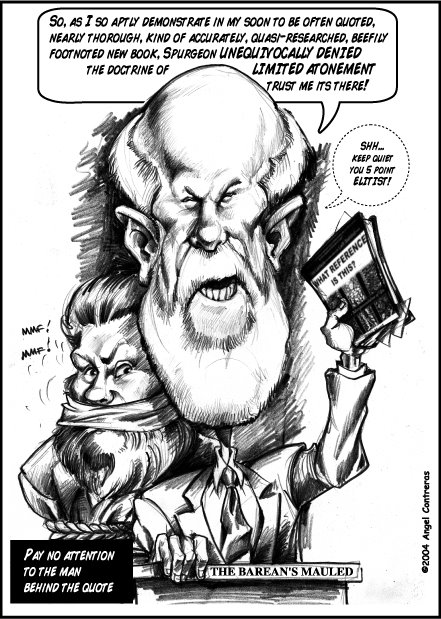
In the reformed communities, Dave Hunt's name has become synonymous with such terms and phrases as, misrepresentation, ad hominem, charicature, poor research, and dishonesty. This concensus stems largely from Dave Hunt's polemical work entitled, "What Love Is This?". This work hit the bookshelves in 2002 and almost immediately, James White of Alpha and Omega Ministries began the tedious task of documenting the errors that permeated the pages of "What Love Is This?" (hereafter referred to as WLIT). It wasn't long before Dave Hunt's own ministry began to lose revenue due to WLIT and eventually was forced into publishing the work himself thru his own ministry due to his publisher refusing to put out the second edition. Amazingly, Hunt has recently released a third edition of WLIT despite the fact that he is still being forced to self-publish the book.
Now, as mentioned above, James White has documented many gross errors contained within WLIT (both first and second editions) and others that have sprang from Dave Hunt's ministry and writing. Some examples of White's documentation are:
- Hunt's statement that Charles Spurgeon "unequivocally" denied limited atonement (see here)
- Hunt's endorsement of the New World Translation's rendering of Acts 13:48 (see here)
- Hunt's exegetical error on 1John 5:1 and the subsequent retraction of his statements in regards to the same in the second edition of WLIT (see here)
- Hunt blaming the refusal of his publisher to print the second edition of WLIT on some great "Calvinistic conspiracy" (see here)
- The now infamous "Hebrew original" of Acts 1-15 (see here)
After reading thru these examples coupled with listening to White's audio files, one wonders how anyone in their right mind could endorse Dave Hunt's work. Indeed, I was surprised to find an individual recently who not only bought WLIT, but was aggressively defending both Hunt and his book. And what's sad is that no matter how many times Hunt's errors are demonstrated, this individual believes Hunt to be right and everyone else to be wrong including Laurence Vance whose criticism on parts of WLIT was written off by this individual as being biased.
Also, this person at one point linked to a Q & A section of Hunt's site in which I found this interesting tidbit:
Sadly, with few exceptions, most of the Calvinists who write to me make similar unsupported charges. For example, see James White's response to my book, What Love Is This? -Dave Hunt
This statement was made in response to a letter Hunt receieved that was critical of his work in regards to Calvinism. The charges made against Hunt are similiar, if not identical to many of White's own criticisms of Hunt. Yet, Hunt says that not only are the charges unsupported, but White's charges are equally unsupported. Undoubtedly, Hunt is referring to White's open letter that was written and posted to White's site soon after WLIT was released. And as anyone can see, White's open letter (which is also linked above) is lengthy and full of documentation of White's charges. In light of this, I dare say that Hunt's statement above is a bold-faced lie. There simply is no other way of looking at it. For Hunt to dismiss White's open letter as "unsupported charges", is outright dishonesty on Hunt's part. It is precisely this, coupled with the documentation on James White's site, that justifies and strengthens the reformed community's opinion of Hunt and his work. And it is this sort of thing that is ignored and/or explained away by ardent supporters of Hunt such as the aforementioned individual. Indeed, since White's documentation shows Hunt to be immune to correction, can we really expect Hunt's supporters to be any different?
Tuesday, August 15, 2006
The Servetus Maneuver
I love Star Trek. Specifically, I love the "Next Generation". I remember one of the earlier episodes in which Captain Picard, while on board his previous ship, the Stargazer, had been brainwashed into believing that he was re-living a past battle in which he was forced to destroy an attacking ship. During that battle, Picard came up with an unorthadox maneuver that would eventually be labeled, the "Picard Maneuver", a tactic that had no known defense. So while brainwashed and still aboard the Stargazer, Picard believed that the Enterprise was the attacking ship from the past and was preparing to repeat his patented maneuver. But as one may guess, the crew of the Enterprise did figure a way out of the whole situation and they went on to explore the galaxy happily ever after.
In like manner, non-Calvinists and unbelievers alike will employ the "Servetus Maneuver" whenever they are faced with Calvinist opposition. This tactic is often used as a last ditch effort when confronted with superior argumentation or, in place of an argument to begin with because everyone knows the "Servetus Maneuver" cannot be defended. Or, so the non-Calvinist assumes. The problem with the "Servetus Maneuver" is that those who employ it have great difficulty answering the question of just why the burning of Servetus automatically falsifies Calvin's theological viewpoints. The main thrust of this tactic is to paint Calvin as being as tyrannical and blood-thirsty as Vlad the Impaler himself, so that anything and everything about the man was just wrong. But even if it be granted that Calvin was a religous Hitler, the logical fallacy remains. The one employing this tactic is still left with refuting Calvin's views biblically. At any rate, both Steve Hays and Gene Bridges of Triablogue have recently addressed the issue of Servetus and everyone is encouraged to peruse their handling of this issue.
In like manner, non-Calvinists and unbelievers alike will employ the "Servetus Maneuver" whenever they are faced with Calvinist opposition. This tactic is often used as a last ditch effort when confronted with superior argumentation or, in place of an argument to begin with because everyone knows the "Servetus Maneuver" cannot be defended. Or, so the non-Calvinist assumes. The problem with the "Servetus Maneuver" is that those who employ it have great difficulty answering the question of just why the burning of Servetus automatically falsifies Calvin's theological viewpoints. The main thrust of this tactic is to paint Calvin as being as tyrannical and blood-thirsty as Vlad the Impaler himself, so that anything and everything about the man was just wrong. But even if it be granted that Calvin was a religous Hitler, the logical fallacy remains. The one employing this tactic is still left with refuting Calvin's views biblically. At any rate, both Steve Hays and Gene Bridges of Triablogue have recently addressed the issue of Servetus and everyone is encouraged to peruse their handling of this issue.
Thursday, August 10, 2006
Pelagius Wannabe
An anonymous commenter going by the name "Pelagius", visited my blog recently and posted his thoughts on a particuliar entry of mine, and on Calvinism in general. Here is what he said (with my comments interspersed):
I laud you for your intellectual honesty even though I am a Finney Presbyterian and disagree with your theology.
A Finney Presbyterian? Didn't that used to be an oxymoron?
As you point out in your post, most Calvinists deny that under their system of theology; which is predicated on the Eternal Decree; God is according to Reformed theology - the author of sin.
Pelagius seems to think that I believe God to be the author of evil whereas, most Calvinists do not. But what I stated was that, while Calvinists deny that God is the author of evil, they will admit to God being the ultimate cause of all things and that nothing occurs but by His will. As I pointed out in my last blog entry, Calvinists use the term "author" differently in theological contexts. The Westminster Confession of Faith states:
God from all eternity did, by the most wise and holy counsel of his own will, freely and unchangeably ordain whatsoever comes to pass; yet so, as thereby neither is God the author of sin, nor is violence offered to the will of the creatures, nor is the liberty or contingency of second causes tatken away, but rather established...
I, and every Calvinist author I have read affirm these words. So what Pelagius fails to do is to address how the Calvinist defines the term "author" in theological contexts, and also fails to address the distinction between *primary* and *secondary* causation. Since Pelagius offers no argumentation to these distinctions, nothing further need be said here.
Calvinism is a system of necessity and precludes any liberty, free will, free agency or second causes.
Yes, Calvinism is a system of necessity but it does not preclude liberty, free-will, or free-agency. What Pelagius is doing here is smuggling in his views of Libertarianism and human autonomy under the guise of these terms. He fails to mention the competing theories of man's will such as Compatiblism. Like most non-Calvinists, Pelagius assumes his particuliar theory of man's will without benefit of argument.
When theologians attempt to get around this logical truth, they create a host of philosophical and logical problems and inconsistencies.
Notice how Pelagius proceeds to criticize Calvinism based on his unsupported assumptions of how free-will and liberty are properly defined. This is the fallacy known as "question begging".
Surprisingly Hodge's Systematic Theology is full of contradictions and errors - all because he wants to maintain the concept of free agency and free will;
Notice again how Pelagius does not offer us any examples of Hodge's supposed contradictions and errors. Though I haven't read Hodge's Systematic Theology, I assume that Hodge at some point affirms free-will and free-agency but defines these terms according to deterministic/compatiblistic thinking. If so, then Pelagius is still begging the question because he hasn't bothered to demonstrate just why Libertarian free-will is correct and why compatiblistic free-will is in error.
"I must admit, the scriptures that you have quoted do not charge God with sin."
Nor did I mean for them to. The verses I briefly examined address God's relationship to evil. I have never claimed that God sins nor do I know of any Calvinist who has. Undoubtedly, Pelagius means to say that he disagrees with my assesment of the verses covered in my article. But again, he offers no argument which causes me to wonder what this fellow's purpose was in posting this response since without supporting argumentation to the assertions made, it is pointless.
I laud you for your intellectual honesty even though I am a Finney Presbyterian and disagree with your theology.
A Finney Presbyterian? Didn't that used to be an oxymoron?
As you point out in your post, most Calvinists deny that under their system of theology; which is predicated on the Eternal Decree; God is according to Reformed theology - the author of sin.
Pelagius seems to think that I believe God to be the author of evil whereas, most Calvinists do not. But what I stated was that, while Calvinists deny that God is the author of evil, they will admit to God being the ultimate cause of all things and that nothing occurs but by His will. As I pointed out in my last blog entry, Calvinists use the term "author" differently in theological contexts. The Westminster Confession of Faith states:
God from all eternity did, by the most wise and holy counsel of his own will, freely and unchangeably ordain whatsoever comes to pass; yet so, as thereby neither is God the author of sin, nor is violence offered to the will of the creatures, nor is the liberty or contingency of second causes tatken away, but rather established...
I, and every Calvinist author I have read affirm these words. So what Pelagius fails to do is to address how the Calvinist defines the term "author" in theological contexts, and also fails to address the distinction between *primary* and *secondary* causation. Since Pelagius offers no argumentation to these distinctions, nothing further need be said here.
Calvinism is a system of necessity and precludes any liberty, free will, free agency or second causes.
Yes, Calvinism is a system of necessity but it does not preclude liberty, free-will, or free-agency. What Pelagius is doing here is smuggling in his views of Libertarianism and human autonomy under the guise of these terms. He fails to mention the competing theories of man's will such as Compatiblism. Like most non-Calvinists, Pelagius assumes his particuliar theory of man's will without benefit of argument.
When theologians attempt to get around this logical truth, they create a host of philosophical and logical problems and inconsistencies.
Notice how Pelagius proceeds to criticize Calvinism based on his unsupported assumptions of how free-will and liberty are properly defined. This is the fallacy known as "question begging".
Surprisingly Hodge's Systematic Theology is full of contradictions and errors - all because he wants to maintain the concept of free agency and free will;
Notice again how Pelagius does not offer us any examples of Hodge's supposed contradictions and errors. Though I haven't read Hodge's Systematic Theology, I assume that Hodge at some point affirms free-will and free-agency but defines these terms according to deterministic/compatiblistic thinking. If so, then Pelagius is still begging the question because he hasn't bothered to demonstrate just why Libertarian free-will is correct and why compatiblistic free-will is in error.
"I must admit, the scriptures that you have quoted do not charge God with sin."
Nor did I mean for them to. The verses I briefly examined address God's relationship to evil. I have never claimed that God sins nor do I know of any Calvinist who has. Undoubtedly, Pelagius means to say that he disagrees with my assesment of the verses covered in my article. But again, he offers no argument which causes me to wonder what this fellow's purpose was in posting this response since without supporting argumentation to the assertions made, it is pointless.
Sunday, August 06, 2006
The Face of Evil

The wrath of God is being revealed from heaven against all the godlessness and wickedness of men who suppress the truth by their wickedness, since what may be known about God is plain to them, because God has made it plain to them. For since the creation of the world God's invisible qualities - his eternal power and divine nature - have been clearly seen, being understood from what has been made, so that men are without excuse. For although they knew God, they neither glorified him as God nor gave thanks to him, but their thinking became futile and their foolish hearts were darkened. Although they claimed to be wise, they became fools... Romans 1:18-22 NIV
These will wage war against the Lamb, and the Lamb will overcome them, because He is Lord of lords and King of kings, and those who are with Him are the called and chosen and faithful...For God has put it in their hearts to execute His purpose by having a common purpose, and by giving their kingdom to the beast, until the words of God will be fulfilled. Revelation 17:14 & 17 NASB
Wednesday, July 19, 2006
Response To "Alpha"
"Alpha" had this to say in response to my earlier post titled, "God's Relationship to Evil":
Thank you for allowing me to respond to your post. I am not a Calvinist or Reformed Doctrine follower but perhaps we both can learn from one another.
And thank you for taking the time to post your thoughts on what I have written. But before we go any further, I would like to clarify that I do not "follow" anything or anyone other than Christ. I mention this so as to hopefully avoid any accusations that I follow Calvin instead of Christ. As long as this canard is avoided, I believe that we may indeed be able to learn something here. Moving on:
I list below a very clear section of scripture from the Lord in Jeremiah 19. Verse 5 clearly refutes the reformed position and the following claim within your earlier post-“However, the Calvinist at some point must admit that Reformed theology affirms God as the ultimate cause of all things and thatnothing occurs but by His will”.
Jeremiah 19:5 reads:
and have built the hight places of Baal to burn their sons in the fire as burnt offerings to Baal, a thing which I never commanded or spoke of, nor did it ever enter My mind; NASB
In Jeremiah 19, the LORD is rebuking Israel for turning to heathen gods (in this case Baal) and for offering their sons as burnt offerings. Verse 5 states that God did not command or speak these things to the Israelites. The LORD further states that these things the Israelites were doing did not "enter His mind". Alpha's contention seems to be focused on this last phrase. Apparantly, these things not "entering" the mind of God refutes the notion that God decrees all things that take place. But why should we accept this? Alpha doesn't present an argument for why Jeremiah 19:5 contradicts Calvinism. Alpha simply says it does. As it is, the verse is recording God's assurance that He did not in any way command or approve the actions of the Israelites. Alpha needs to demonstrate a contradiction between what is written in v. 5 with the Calvinistic notions of God's preceptive will and decretal will.
Mat 23:37, Acts 7:49-52, and Proverbs 1:22-31 are additional scriptures to support that not all things are authored by the Lord.
I do not see anything in Acts 7 or Proverbs 1 that speaks directly to the issues at hand. As for Matthew 23:37, much can be (and has been) said here. Calvinists have written extensively on this verse and have effectively removed it from the arsenal of the non-Calvinist. For a thorough exegetical discussion of Matthew 23, click here.
I maintain that GOD permits all things for HIS ultimate GLORY.
And I would say that God "works all things after the counsel of His will". I see no reason to maintain that God merely permits things to happen in light of the fact that none of the verses I covered stated anything about God merely "permitting" evil. Further, this would be a double-standard. That is, folks who hold the view that God permits evil that He knew about before hand but did nothing to stop it, is guilty of inconsistency in that these same folks would hold any person accountable for the same thing. For example, a lifeguard that "permitted" a child to drown because he simply didn't feel like getting wet on that particuliar day, would be held accountable for the child's death (and probably buried under the jail to boot). So the obvious question is, since God isn't being held accountable, why is man?
Moving on:
The Bible says he changes not:
And I agree. It was never my argument that He does.
Now to address the verses in question.
Yes, lets. But, for the sake of brevity and simplicity, I am going to address one commentary at a time. In other words, if Alpha wishes to interact with this post, we can discuss the verses in question and Alpha's comments on those verses one post at a time in either the comments section of this post or the home page.
The first verse I would like to address in regards to Alpha's comments is Acts 4:28. Alpha said:
My reply to this is statement is to turn your Bible to Acts 2:23 and see emphatically where through GODS foreknowledge the cast of characters you listed earlier would crucify our beloved Jesus.
In order to answer what Acts 4:28 states, Alpha takes us to Acts 2:23 where the term "foreknowledge" is mentioned (incidentally, this is what I originally said would be done by a non-Calvinist). The problem here is that Alpha assumes that the term "foreknowledge" means what he thinks it means but provides no supporting argument. In other words, Alpha fails to demonstrate that God determines because He foreknows instead of God foreknowing because He determines. The text of Acts 2 does not lay out the "simple foreknowledge" view that Alpha apparantly endorses. So in order for Alpha to succeed in refuting my comments on Acts 4, he would need to demonstrate the simple foreknowledge view (mere prescience) from the text of scripture.
I also wish to thank you for allowing me to post on your blog. I realize that it may stretch very long but it was necessary to clarify and perhaps enlighten others in the future. It is my hope that what I have offered is of help.
And, again, thanks for taking the time to post your thoughts. Now, as to your comments on clarifying and enlightening myself or any other Calvinists who may read what you have posted, I must say that you will need to present arguments for all that you contend since much of what you posted was assertive in nature. That is, many of the scriptures you posted or cited to counter what I originally discussed in my article was not accompanied by argumentation (such as Mat. 23:37). As I said above, if you wish to continue to dialogue on the verses in dispute, we can begin at Acts 4.
God Bless You... alpha
And may God bless you as well.
Thank you for allowing me to respond to your post. I am not a Calvinist or Reformed Doctrine follower but perhaps we both can learn from one another.
And thank you for taking the time to post your thoughts on what I have written. But before we go any further, I would like to clarify that I do not "follow" anything or anyone other than Christ. I mention this so as to hopefully avoid any accusations that I follow Calvin instead of Christ. As long as this canard is avoided, I believe that we may indeed be able to learn something here. Moving on:
I list below a very clear section of scripture from the Lord in Jeremiah 19. Verse 5 clearly refutes the reformed position and the following claim within your earlier post-“However, the Calvinist at some point must admit that Reformed theology affirms God as the ultimate cause of all things and thatnothing occurs but by His will”.
Jeremiah 19:5 reads:
and have built the hight places of Baal to burn their sons in the fire as burnt offerings to Baal, a thing which I never commanded or spoke of, nor did it ever enter My mind; NASB
In Jeremiah 19, the LORD is rebuking Israel for turning to heathen gods (in this case Baal) and for offering their sons as burnt offerings. Verse 5 states that God did not command or speak these things to the Israelites. The LORD further states that these things the Israelites were doing did not "enter His mind". Alpha's contention seems to be focused on this last phrase. Apparantly, these things not "entering" the mind of God refutes the notion that God decrees all things that take place. But why should we accept this? Alpha doesn't present an argument for why Jeremiah 19:5 contradicts Calvinism. Alpha simply says it does. As it is, the verse is recording God's assurance that He did not in any way command or approve the actions of the Israelites. Alpha needs to demonstrate a contradiction between what is written in v. 5 with the Calvinistic notions of God's preceptive will and decretal will.
Mat 23:37, Acts 7:49-52, and Proverbs 1:22-31 are additional scriptures to support that not all things are authored by the Lord.
I do not see anything in Acts 7 or Proverbs 1 that speaks directly to the issues at hand. As for Matthew 23:37, much can be (and has been) said here. Calvinists have written extensively on this verse and have effectively removed it from the arsenal of the non-Calvinist. For a thorough exegetical discussion of Matthew 23, click here.
I maintain that GOD permits all things for HIS ultimate GLORY.
And I would say that God "works all things after the counsel of His will". I see no reason to maintain that God merely permits things to happen in light of the fact that none of the verses I covered stated anything about God merely "permitting" evil. Further, this would be a double-standard. That is, folks who hold the view that God permits evil that He knew about before hand but did nothing to stop it, is guilty of inconsistency in that these same folks would hold any person accountable for the same thing. For example, a lifeguard that "permitted" a child to drown because he simply didn't feel like getting wet on that particuliar day, would be held accountable for the child's death (and probably buried under the jail to boot). So the obvious question is, since God isn't being held accountable, why is man?
Moving on:
The Bible says he changes not:
And I agree. It was never my argument that He does.
Now to address the verses in question.
Yes, lets. But, for the sake of brevity and simplicity, I am going to address one commentary at a time. In other words, if Alpha wishes to interact with this post, we can discuss the verses in question and Alpha's comments on those verses one post at a time in either the comments section of this post or the home page.
The first verse I would like to address in regards to Alpha's comments is Acts 4:28. Alpha said:
My reply to this is statement is to turn your Bible to Acts 2:23 and see emphatically where through GODS foreknowledge the cast of characters you listed earlier would crucify our beloved Jesus.
In order to answer what Acts 4:28 states, Alpha takes us to Acts 2:23 where the term "foreknowledge" is mentioned (incidentally, this is what I originally said would be done by a non-Calvinist). The problem here is that Alpha assumes that the term "foreknowledge" means what he thinks it means but provides no supporting argument. In other words, Alpha fails to demonstrate that God determines because He foreknows instead of God foreknowing because He determines. The text of Acts 2 does not lay out the "simple foreknowledge" view that Alpha apparantly endorses. So in order for Alpha to succeed in refuting my comments on Acts 4, he would need to demonstrate the simple foreknowledge view (mere prescience) from the text of scripture.
I also wish to thank you for allowing me to post on your blog. I realize that it may stretch very long but it was necessary to clarify and perhaps enlighten others in the future. It is my hope that what I have offered is of help.
And, again, thanks for taking the time to post your thoughts. Now, as to your comments on clarifying and enlightening myself or any other Calvinists who may read what you have posted, I must say that you will need to present arguments for all that you contend since much of what you posted was assertive in nature. That is, many of the scriptures you posted or cited to counter what I originally discussed in my article was not accompanied by argumentation (such as Mat. 23:37). As I said above, if you wish to continue to dialogue on the verses in dispute, we can begin at Acts 4.
God Bless You... alpha
And may God bless you as well.
Monday, July 03, 2006
Anti-Calvinism At It's Worst
Every Calvinist who has spent any time trying to witness to others the truth of the doctrines of grace has experienced what can only be called "anti-Calvinism". Anti-Calvinism can be characterized by sheer hatred of the doctrines of grace and the willingness to attack them by any means neccessary. Every logical fallacy from ad hominem to outright dishonesty can and will be employed by anti-Calvinists in order to gain any percieved ground in their holy war against what is so plainly taught in scripture. The single most shameful fact in this is that the typical anti-Calvinist is a professing Christian. These professing Christians will drop every standard of holiness, civility, and honesty in order to paint Calvinism in the worst light possible. Nothing can be more saddening than to watch a brother act like a trial lawyer, skillfully sowing the seeds of doubt to get his guilty client off the hook.
Now, I occasionally visit one of those web boards where folks can post on various topics related to and about Christian doctrine and I ran across one such anti-Calvinist named Bill Johnston. I attempted a dialogue with Bill because he seemed sincere and willing to openly discuss issues related to the doctrines of grace. Unfortunatly, Bill turned out to be one of the worst anti-Calvinists that I've ran across. What makes Bill such a bad anti-Calvinist is the fact that he knows very little about Calvinism and has admitted such. In fact, Bill makes Dennis Clough look scholarly. Below are some of Bill's statements from the aforementioned web board and my comments concerning them. I believe it's worth calling attention to this sort of behavior due to the fact that so many professing Christians will engage in it. It is my hope that at least one non-Calvinist out there will read this and evaluate if his/her argumentation is any better. note: these quotes do not appear in chronological order.
No, you chose to believe God is unjust by providing salvation for some, but not for others. You've been lied to, pal!
Bill says that Calvinists believe God to be unjust. Of course, we don't and Bill has been told this but Bill doesn't care. Bill believes that if God doesn't give all men since the time of Christ a chance to "get saved" then God is unjust. When I confronted Bill about those who lived in the new world and Australia during and immediatly after the time of Christ, and how they might have recieved the gospel, his response was one of those "All I know is..." statements. Bill still hasn't faced this issue squarely.
But, I don't suppose you guys witness to anyone, since you don't know who is chosen and who isn't, right?
Here, Bill muses that Calvinists do not witness to folks because we don't know who the elect are. Bill has been corrected on this as well but he has refused to listen. At any rate, Calvinists witness to any and all precisely because we don't know who the elect are. Calvinists believe that preaching is the means to God's ends in bringing His elect to His Son. In other words, we believe that God ordains the means along with the ends. Thus, preaching to all is in complete harmony with Calvinistic theology.
Jesus told us to go preach the Gospel to everybody, so it's obvious He didn't believe like you do. Thank God
Yes, Jesus told us to preach to all men. As stated above, Calvinists affirm this. But notice how Bill doesn't attempt a demonstration of just how the great commission contradicts anything in Calvinistic theology. Bill relies almost entirely on assertive argumentation and, at times, outright dishonesty.
It's also funny to hear folks like yourself claim that not all are chosen for salvation, but somehow all the people that claim this have been chosen
Kinda like how when the Christian witnesses to the lost, all the while believing that he himself is going to heaven while the person he is witnessing to is headed for hell, right? Oh, and never mind that Christians are referred to as "the chosen" many times in scripture.
That's always funny to me! Are there any in your group that have been chosen to go to hell?
What's funny is that this statement is no different than suggesting that a Christian is hell-bound. Further, this question is loaded and designed to mock Calvinism. It demonstrates unequivically that Bill is not serious about any of the issues surrounding the doctrines of grace. Since he cannot hope to refute Calvinism with such argumentation, what reason is there for him to act in this manner outside of sheer spite?
I've never heard such a crock of cr*ap in all my life that God created some people to go to hell, which obviously means you believe it is God's will for some folks to burn forever!
Aside from the fact that Bill is having to censure himself, this question bears just as much on his own position. For instance, Bill believes that God had perfect knowledge of all future things. This means that God knew that the majority of mankind would reject Him and end up in hell. But God chose to create anyway knowing these people would live and die without ever having hope that things would turn out different. If they did, then God's knowledge would be imperfect. So can Bill explain why God created men who had no hope of salvation? Would Bill even acknowledge the problem beyond "All I know is..."?
Bill takes his argumentation to new lows with these next two statements...
That's right, because I refuse to see things from the devil's point of view!
What? Now, why would I want to allow the devil to decieve me into believing like you?
The first statement was in response to me pointing out that he is attacking a belief system that he knows little about. Again I ask, what is to be gained in this kind of argumentation? It cannot be a concern for truth because there is no demonstration of truth in either of these statements. Again, I can only conclude that what is driving Bill at this point is pure spite.
This is classic cultism that claims "we are all saved, but God appointed some from outside our little group to go to hell....but, none of us of course because we are all saved!"
You tell those calvin cult followers!
Here in these two quotes, Bill resorts to calling Calvinists "cultists" (nevermind the fact that he doesn't bother to show just why). Since cults lie outside of what's accepted as Christianity, I can only conclude that Bill's opinion of Calvinists is that they are not Christians. Now, if Calvinists who believe this about non-Calvinists are called "hyper-Calvinists", why can't Bill be called a "hyper-Arminian"? At any rate, belief in predestination does not qualify anyone for cult status anymore than does believing that musical instruments are not acceptable for worship.
calvinism is nothing more than a pimple on the butt of the Body of Christ. One that needs to be popped!
This one I'll let stand without commentary as it says more than I could hope to about Bill's argumentation.
If you truly believe God fixed things so some people don't have any way of getting saved, then you serve a mean, ugly, evil god!
Only at death will any of us know for certain if we were right in accepting or rejecting Calvinism. If Bill is wrong in rejecting it, then he will one day stand before God to give an account for what he has said about Him publically all the while professing to be His child.
So, what is a "Calvinist" believe anyway? Can you name off a few points of exactly what they believe?
I don't follow calvin, or armin, or any other such foolishness. I simply read what God says and believe it.
Here, in these final two quotes, Bill displays his lack of knowledge concering this ancient debate. He asks what a Calvinist believes from, oddly enough, a non-Calvinist. The problem here is obvious. Instead of interacting with Calvinists about their beliefs, he chooses to ask a non-Calvinist for information while continuing to belittle and attack Calvinists. He further says that he does not follow Calvin or Armin (Armin?). Anyway, there is certainly nothing wrong with ignorance. We are all ignorant of a great many things. The problems begin when one tries to attack something that he doesn't understand. This axiom has been shown to be true too many times to count. Bill has been told that he doesn't understand Calvinism but that doesn't seem to matter to him. What little Bill knows, he hates. And as of this writing, Bill is still at it with no more knowledge than when he first started making the kinds of statements quoted above. As a professing Christian, Bill is supposed to be a lover of truth no matter what that truth might be. To know the truth requires a willingness to investigate. Bill lacks this quality and I believe that only God can give it to him. For the sake of those who frequent that particuliar message board, may it be soon. And for the Calvinists who frequent this blog, may your contact with anti-Calvinists such as Bill be few and far between!
Now, I occasionally visit one of those web boards where folks can post on various topics related to and about Christian doctrine and I ran across one such anti-Calvinist named Bill Johnston. I attempted a dialogue with Bill because he seemed sincere and willing to openly discuss issues related to the doctrines of grace. Unfortunatly, Bill turned out to be one of the worst anti-Calvinists that I've ran across. What makes Bill such a bad anti-Calvinist is the fact that he knows very little about Calvinism and has admitted such. In fact, Bill makes Dennis Clough look scholarly. Below are some of Bill's statements from the aforementioned web board and my comments concerning them. I believe it's worth calling attention to this sort of behavior due to the fact that so many professing Christians will engage in it. It is my hope that at least one non-Calvinist out there will read this and evaluate if his/her argumentation is any better. note: these quotes do not appear in chronological order.
No, you chose to believe God is unjust by providing salvation for some, but not for others. You've been lied to, pal!
Bill says that Calvinists believe God to be unjust. Of course, we don't and Bill has been told this but Bill doesn't care. Bill believes that if God doesn't give all men since the time of Christ a chance to "get saved" then God is unjust. When I confronted Bill about those who lived in the new world and Australia during and immediatly after the time of Christ, and how they might have recieved the gospel, his response was one of those "All I know is..." statements. Bill still hasn't faced this issue squarely.
But, I don't suppose you guys witness to anyone, since you don't know who is chosen and who isn't, right?
Here, Bill muses that Calvinists do not witness to folks because we don't know who the elect are. Bill has been corrected on this as well but he has refused to listen. At any rate, Calvinists witness to any and all precisely because we don't know who the elect are. Calvinists believe that preaching is the means to God's ends in bringing His elect to His Son. In other words, we believe that God ordains the means along with the ends. Thus, preaching to all is in complete harmony with Calvinistic theology.
Jesus told us to go preach the Gospel to everybody, so it's obvious He didn't believe like you do. Thank God
Yes, Jesus told us to preach to all men. As stated above, Calvinists affirm this. But notice how Bill doesn't attempt a demonstration of just how the great commission contradicts anything in Calvinistic theology. Bill relies almost entirely on assertive argumentation and, at times, outright dishonesty.
It's also funny to hear folks like yourself claim that not all are chosen for salvation, but somehow all the people that claim this have been chosen
Kinda like how when the Christian witnesses to the lost, all the while believing that he himself is going to heaven while the person he is witnessing to is headed for hell, right? Oh, and never mind that Christians are referred to as "the chosen" many times in scripture.
That's always funny to me! Are there any in your group that have been chosen to go to hell?
What's funny is that this statement is no different than suggesting that a Christian is hell-bound. Further, this question is loaded and designed to mock Calvinism. It demonstrates unequivically that Bill is not serious about any of the issues surrounding the doctrines of grace. Since he cannot hope to refute Calvinism with such argumentation, what reason is there for him to act in this manner outside of sheer spite?
I've never heard such a crock of cr*ap in all my life that God created some people to go to hell, which obviously means you believe it is God's will for some folks to burn forever!
Aside from the fact that Bill is having to censure himself, this question bears just as much on his own position. For instance, Bill believes that God had perfect knowledge of all future things. This means that God knew that the majority of mankind would reject Him and end up in hell. But God chose to create anyway knowing these people would live and die without ever having hope that things would turn out different. If they did, then God's knowledge would be imperfect. So can Bill explain why God created men who had no hope of salvation? Would Bill even acknowledge the problem beyond "All I know is..."?
Bill takes his argumentation to new lows with these next two statements...
That's right, because I refuse to see things from the devil's point of view!
What? Now, why would I want to allow the devil to decieve me into believing like you?
The first statement was in response to me pointing out that he is attacking a belief system that he knows little about. Again I ask, what is to be gained in this kind of argumentation? It cannot be a concern for truth because there is no demonstration of truth in either of these statements. Again, I can only conclude that what is driving Bill at this point is pure spite.
This is classic cultism that claims "we are all saved, but God appointed some from outside our little group to go to hell....but, none of us of course because we are all saved!"
You tell those calvin cult followers!
Here in these two quotes, Bill resorts to calling Calvinists "cultists" (nevermind the fact that he doesn't bother to show just why). Since cults lie outside of what's accepted as Christianity, I can only conclude that Bill's opinion of Calvinists is that they are not Christians. Now, if Calvinists who believe this about non-Calvinists are called "hyper-Calvinists", why can't Bill be called a "hyper-Arminian"? At any rate, belief in predestination does not qualify anyone for cult status anymore than does believing that musical instruments are not acceptable for worship.
calvinism is nothing more than a pimple on the butt of the Body of Christ. One that needs to be popped!
This one I'll let stand without commentary as it says more than I could hope to about Bill's argumentation.
If you truly believe God fixed things so some people don't have any way of getting saved, then you serve a mean, ugly, evil god!
Only at death will any of us know for certain if we were right in accepting or rejecting Calvinism. If Bill is wrong in rejecting it, then he will one day stand before God to give an account for what he has said about Him publically all the while professing to be His child.
So, what is a "Calvinist" believe anyway? Can you name off a few points of exactly what they believe?
I don't follow calvin, or armin, or any other such foolishness. I simply read what God says and believe it.
Here, in these final two quotes, Bill displays his lack of knowledge concering this ancient debate. He asks what a Calvinist believes from, oddly enough, a non-Calvinist. The problem here is obvious. Instead of interacting with Calvinists about their beliefs, he chooses to ask a non-Calvinist for information while continuing to belittle and attack Calvinists. He further says that he does not follow Calvin or Armin (Armin?). Anyway, there is certainly nothing wrong with ignorance. We are all ignorant of a great many things. The problems begin when one tries to attack something that he doesn't understand. This axiom has been shown to be true too many times to count. Bill has been told that he doesn't understand Calvinism but that doesn't seem to matter to him. What little Bill knows, he hates. And as of this writing, Bill is still at it with no more knowledge than when he first started making the kinds of statements quoted above. As a professing Christian, Bill is supposed to be a lover of truth no matter what that truth might be. To know the truth requires a willingness to investigate. Bill lacks this quality and I believe that only God can give it to him. For the sake of those who frequent that particuliar message board, may it be soon. And for the Calvinists who frequent this blog, may your contact with anti-Calvinists such as Bill be few and far between!
Saturday, July 01, 2006
The Conversion of Lydia
Sometime ago, I happened upon a web page critiquing Calvinism that was written by a self-professed former Calvinist named Steve Jones. During Mr. Jones' discussions on the five points, he briefly mentions the story of Lydia found in Acts 16. Here are his comments:
The conversion of Lydia (Acts 16:14) does not prove the Calvinist's point. God was not here opening the heart of a totally depraved rebel. She was already "a worshipper of God," not a so-called "spiritual corpse."
Mr. Jones' argument appears to be that Lydia was already a believer. Thus, the reference to God opening her heart should not be understood as God causing Lydia to accept the Gospel message. Rather, this would be looked at as some sort of post-conversion blessing being bestowed by God. Now, I didn't then, nor do I now believe that Mr. Jones' brief treatment of Acts 16 is compelling and worth even responding to. However, I saw where a commenter on a reformed blog used this same argument recently. This caused me to wonder if Mr. Jones' understanding of Lydia's conversion was a common one so I thought that I would go ahead and offer a few observations.
First, here is Acts 16:14 as it reads in the NASB under the heading of (ironically) "First Convert in Europe":
A woman named Lydia, from the city of Thyatira, a seller of purple fabrics, a worshiper of God, was listening; and the Lord opened her heart to respond to the things spoken by Paul.
The verse states that God opened Lydia's heart so that she would respond to Paul's preaching. The very next verse states that Lydia and her house-hold were baptized after this response to Paul's preaching. The Calvinist argument is that Lydia, despite being a "worshipper of God" was not a Christian convert before Paul's sermon. Her acceptance of Paul's words came only after God enabled her to respond. Lydia's conversion to Christianity at this point is evidenced by her baptism afterwards. Also, the Calvinist's view of free-will (i.e. compatiblism) is consistent with these events as described by the biblical narrative.
Now, Mr. Jones' objection seems to be based solely on the phrase "worshipper of God". He appears to be assuming that this phrase demands one to be a Christian convert. But I would only point out that the Pharisees themselves were "worshippers of God". Indeed, modern practicing Jews can be said to be "worshippers of God". Even Christ Himself stated that people honor Him with their lips while their hearts were far from Him (Matthew 15:8,9). Obviously, this phrase does not demand a Christian conversion. Also, if Lydia were already a Christian, why would God need to open Lydia's heart to respond to Paul's preaching? Why would Lydia put off baptism until that point if she were already converted? It would seem that in order for Mr. Jones' interpretation to hold up he would need to:
Until these issues are dealt with by non-Calvinists who are in agreement with Mr Jones, I see no reason to amend my original evaluation of Mr. Jones' comments on Lydia's conversion.
The conversion of Lydia (Acts 16:14) does not prove the Calvinist's point. God was not here opening the heart of a totally depraved rebel. She was already "a worshipper of God," not a so-called "spiritual corpse."
Mr. Jones' argument appears to be that Lydia was already a believer. Thus, the reference to God opening her heart should not be understood as God causing Lydia to accept the Gospel message. Rather, this would be looked at as some sort of post-conversion blessing being bestowed by God. Now, I didn't then, nor do I now believe that Mr. Jones' brief treatment of Acts 16 is compelling and worth even responding to. However, I saw where a commenter on a reformed blog used this same argument recently. This caused me to wonder if Mr. Jones' understanding of Lydia's conversion was a common one so I thought that I would go ahead and offer a few observations.
First, here is Acts 16:14 as it reads in the NASB under the heading of (ironically) "First Convert in Europe":
A woman named Lydia, from the city of Thyatira, a seller of purple fabrics, a worshiper of God, was listening; and the Lord opened her heart to respond to the things spoken by Paul.
The verse states that God opened Lydia's heart so that she would respond to Paul's preaching. The very next verse states that Lydia and her house-hold were baptized after this response to Paul's preaching. The Calvinist argument is that Lydia, despite being a "worshipper of God" was not a Christian convert before Paul's sermon. Her acceptance of Paul's words came only after God enabled her to respond. Lydia's conversion to Christianity at this point is evidenced by her baptism afterwards. Also, the Calvinist's view of free-will (i.e. compatiblism) is consistent with these events as described by the biblical narrative.
Now, Mr. Jones' objection seems to be based solely on the phrase "worshipper of God". He appears to be assuming that this phrase demands one to be a Christian convert. But I would only point out that the Pharisees themselves were "worshippers of God". Indeed, modern practicing Jews can be said to be "worshippers of God". Even Christ Himself stated that people honor Him with their lips while their hearts were far from Him (Matthew 15:8,9). Obviously, this phrase does not demand a Christian conversion. Also, if Lydia were already a Christian, why would God need to open Lydia's heart to respond to Paul's preaching? Why would Lydia put off baptism until that point if she were already converted? It would seem that in order for Mr. Jones' interpretation to hold up he would need to:
- explain why the term "worshipper of God" can only be applied to Christians
- show that Lydia's response was something other than regeneration
- explain why Lydia was not baptized until her encounter with Paul
Until these issues are dealt with by non-Calvinists who are in agreement with Mr Jones, I see no reason to amend my original evaluation of Mr. Jones' comments on Lydia's conversion.
Friday, June 09, 2006
Dennis Clough and Luke 19:10
Readers of my humble blog are no doubt aware that a fellow named Dennis Clough has become a regular visitor here at Conversations. But readers here may not be aware that Mr. Clough is indirectly responsible for the recent increase in visitors to my blog because it was he whom I was responding to on Alan Kurschner's site when Alan graciously recommended my blog to his readers. There is tremendous irony in this because Mr. Clough hates Calvinism and has visited several reformed blogs of late making this known (see for instance Mr. Clough's post here and the many refutations he receieved in response). Despite his visits to these other blogs, Mr. Clough has decided to pitch his tent here, which is fine (that is, as long as he behaves himself) because Mr. Clough has given me much to blog about in the past week or so. Take for example Mr. Clough's assertions in regards to Luke 19:10. Mr. Clough has contended on both Alan's site and here that Luke 19:10 somehow refutes the Calvinistic interpretation of John 6:44. But as we are about to see, Mr. Clough's assertions are not justified.
Here is Luke 19:10 as it reads in the NASB:
For the Son of Man has come to seek and to save that which was lost.
Here, Luke records Jesus as saying that He has come to seek and to save that which was lost. This is a statement by our Lord in regards to His mission here on earth. The question that needs to be answered is just whom is Christ seeking to save? Is it all mankind or a specific group of people? Before we answer this, let's look at two other statements describing our Lord's earthly mission.
The first of these two will be Matthew 1:21 which reads:
She will bear a Son; and you shall call His name Jesus, for He will save His people from their sins. NASB
This was spoken to Joseph by an angel of the Lord. The angel is telling Joseph who Jesus is and what he is coming to do. Jesus' mission is to save His people from their sins. So again, who is it that Jesus saves from their sins? The text states that it is His people who is saved from their sins. So Mr. Clough has two options here. He can insist that all people are Jesus' people or he can say that only some are His. If Mr. Clough chooses all people, then Jesus failed in His mission because not all are saved. If he chooses some people, he must give an answer as to who these people are. The Calvinist of course, says this group is none other than the elect. If not the elect, then who? Mr. Clough might claim that the Jewish nation is in view here. But if this is so, again, Jesus failed in His mission because not all Jews are saved. Clearly, the Calvinistic interpretation is preferred.
The next verse I wish to look at before returning to Luke is John 6:38 & 39 which read:
For I have come down from heaven, not to do My own will, but the will of Him who sent Me. This is the will of Him who sent Me, that of all that He has given Me I lose nothing, but raise it up on the last day. NASB
Here in John 6, Jesus states that His earthly mission is to do the Father's will and that the Father's will is that Jesus lose none of those whom the Father has given Him and to raise them to life. Now, the first thing to notice is just who it is that Christ will not be losing. This is a specific group of people that the Father has given Him. If Mr. Clough tries to insert "all men" here, then what he ends up with is either Universalism or the notion that Christ failed to do the Father's will. Both of these are unacceptable so, what does Mr. Clough do here?
So far, Matthew states Jesus will save His people from their sin, and John says that Jesus will do the Father's will by raising to life all those given to Him. What then of Luke 19:10? We have already noted that v. 10 states that Jesus has come to seek and to save that which was lost. In light of the previous verses, those whom Jesus seeks are His own people. Further, these people are the same ones that the Father has given Him in order to raise them to life. But this is not all. Luke 19:10 falls within the story of Zaccheus the tax collector being converted. Jesus states in verse 19:9 that salvation came to Zaccheus because he was a son of Abraham. So in context, Jesus sought to save the Sons of Abraham. Undoubtedly, the non-Calvinist or perhaps Mr. Clough himself would object to gentiles being referred to as sons of Abraham. But this term is not limited to the jews for two reasons. First, if the term "son of Abraham" were limited to the jews, then Christ failed in his mission because all jews are not saved. This is clearly unacceptable. The second reason is that Scripture identifies Gentiles as also being the sons of Abraham thru faith (Gal. 3:7). So we see that Luke falls in line with Matthew and John on Christ's mission. Contextually, Jesus sought to save the sons of Abraham in Luke. The sons of Abraham are "His people" according to Matthew. And "His people" are the ones whom the Father has given to Christ for the purpose of raising them to life in John.
In looking at these statements of Christ's earthly mission, we have seen that all three refer to a particuliar group of people. This particuliarity in Christ's mission is in complete harmony with the Calvinistic interpretation of John 6:44 because there is no disjunction between those whom Jesus sought to save and those who are drawn to Him by the Father. In order for Mr. Clough's assertions in regards to Luke 19:10 to hold up, he will need to deal with the demonstrated harmony of all three accounts of Christ's earthly mission and then show an inconsistency with the Calvinistic interpretation of John 6:44.
Here is Luke 19:10 as it reads in the NASB:
For the Son of Man has come to seek and to save that which was lost.
Here, Luke records Jesus as saying that He has come to seek and to save that which was lost. This is a statement by our Lord in regards to His mission here on earth. The question that needs to be answered is just whom is Christ seeking to save? Is it all mankind or a specific group of people? Before we answer this, let's look at two other statements describing our Lord's earthly mission.
The first of these two will be Matthew 1:21 which reads:
She will bear a Son; and you shall call His name Jesus, for He will save His people from their sins. NASB
This was spoken to Joseph by an angel of the Lord. The angel is telling Joseph who Jesus is and what he is coming to do. Jesus' mission is to save His people from their sins. So again, who is it that Jesus saves from their sins? The text states that it is His people who is saved from their sins. So Mr. Clough has two options here. He can insist that all people are Jesus' people or he can say that only some are His. If Mr. Clough chooses all people, then Jesus failed in His mission because not all are saved. If he chooses some people, he must give an answer as to who these people are. The Calvinist of course, says this group is none other than the elect. If not the elect, then who? Mr. Clough might claim that the Jewish nation is in view here. But if this is so, again, Jesus failed in His mission because not all Jews are saved. Clearly, the Calvinistic interpretation is preferred.
The next verse I wish to look at before returning to Luke is John 6:38 & 39 which read:
For I have come down from heaven, not to do My own will, but the will of Him who sent Me. This is the will of Him who sent Me, that of all that He has given Me I lose nothing, but raise it up on the last day. NASB
Here in John 6, Jesus states that His earthly mission is to do the Father's will and that the Father's will is that Jesus lose none of those whom the Father has given Him and to raise them to life. Now, the first thing to notice is just who it is that Christ will not be losing. This is a specific group of people that the Father has given Him. If Mr. Clough tries to insert "all men" here, then what he ends up with is either Universalism or the notion that Christ failed to do the Father's will. Both of these are unacceptable so, what does Mr. Clough do here?
So far, Matthew states Jesus will save His people from their sin, and John says that Jesus will do the Father's will by raising to life all those given to Him. What then of Luke 19:10? We have already noted that v. 10 states that Jesus has come to seek and to save that which was lost. In light of the previous verses, those whom Jesus seeks are His own people. Further, these people are the same ones that the Father has given Him in order to raise them to life. But this is not all. Luke 19:10 falls within the story of Zaccheus the tax collector being converted. Jesus states in verse 19:9 that salvation came to Zaccheus because he was a son of Abraham. So in context, Jesus sought to save the Sons of Abraham. Undoubtedly, the non-Calvinist or perhaps Mr. Clough himself would object to gentiles being referred to as sons of Abraham. But this term is not limited to the jews for two reasons. First, if the term "son of Abraham" were limited to the jews, then Christ failed in his mission because all jews are not saved. This is clearly unacceptable. The second reason is that Scripture identifies Gentiles as also being the sons of Abraham thru faith (Gal. 3:7). So we see that Luke falls in line with Matthew and John on Christ's mission. Contextually, Jesus sought to save the sons of Abraham in Luke. The sons of Abraham are "His people" according to Matthew. And "His people" are the ones whom the Father has given to Christ for the purpose of raising them to life in John.
In looking at these statements of Christ's earthly mission, we have seen that all three refer to a particuliar group of people. This particuliarity in Christ's mission is in complete harmony with the Calvinistic interpretation of John 6:44 because there is no disjunction between those whom Jesus sought to save and those who are drawn to Him by the Father. In order for Mr. Clough's assertions in regards to Luke 19:10 to hold up, he will need to deal with the demonstrated harmony of all three accounts of Christ's earthly mission and then show an inconsistency with the Calvinistic interpretation of John 6:44.
Tuesday, June 06, 2006
Calvinist Humor
If any of you out there have ever heard of an atheist named Reggie Finley, a.k.a. the "Infidelguy", then click here. This audio clip is brought to you courtesy of the guys at Fide-O!
Also, this one from Purgatorio, is just plain evil. Click here.
Also, this one from Purgatorio, is just plain evil. Click here.
Friday, June 02, 2006
Calvinism and John 12:32
As I've stated previously, the text of John 6 comes up frequently whenever Calvinism is discussed. Upon being quoted John 6:44, the non-Calvinist's retort is almost always John 12:32 with an accompanying cry of, "All means all!". At this point, it becomes necessary for the Calvinist to address John 12:32 for the sake of progress in the discussion. Since I have had this same defense used against me by two different people in the last two weeks, I would like to discuss a few issues that bear against the non-Calvinist's use of John 12:32.
The first of the above mentioned issues is Universalism. It is the Calvinist's contention that if John 12:32 is read back into 6:44, then the result is an affirmation of Universalism. The reason for this contention is in how both verses read. For instance, 6:44 reads thus:
No one can come to Me unless the Father who sent me draws him; and I will raise him up on the last day. NASB
And John 12:32:
And I, if I am lifted up from the earth, will draw all men to Myself. NASB
The plain reading of John 6:44 is that no one can come to Christ unless first drawn to Him by the Father. Non-Calvinists will often concede this if pressed. It's the rest of the verse that causes problems for them as the verse goes on to state that those who are drawn (represented by "him") are also raised to life by the Son. What non-Calvinists are essentially doing then, is accepting the first half of the verse but denying the second half. This is done by going to John 12:32 and insisting that all men are drawn to Christ. Now, the problem should be obvious. If 6:44 states that all those that are drawn are then raised, and if all men without exception are drawn to Christ per 12:32, then you have an affirmation of Universalism. Since both sides reject Universalism, another explanation must be sought. For the non-Calvinist, this usually means an immediate switch to "all these other verses over here". For the Calvinist, it means dealing with these verses on their own and in their immediate contexts.
Now, when John 12:32 is brought forward by non-Calvinists, there is never any mention about the context in which Jesus makes His statements. The only thing that seems to interest those using this verse against Calvinists is the appearance of the term "all". The assumption is that "all" always means all men everywhere. This assumption remains even when the Calvinist points out that the term "all" is often times limited by contextual considerations. So obviously, the question is what did Jesus mean when He said that He will "draw all men" to Himself? Did He mean all men everywhere, or all *kinds* of men?
The important thing to note about the non-Calvinist's use of this verse is that "all men everywhere" are not in fact drawn to Christ. We know this to be true by both Biblical and experiential considerations. The Pharisees for instance, were not drawn to Christ unless one wishes to count their attempts at killing Him. Further, each of us knows or have known people who have never had an interest in Christianity outside of trying to disprove it. There is also the issue of those who have never heard of Jesus Christ. So, either Jesus was mistaken in what He said, or He did not mean "all men everywhere" but rather, all kinds of men. In support of this, we find in John 12:20 that there were Gentiles who were wishing to see Jesus. When Jesus got word of this, He began to address a crowd that now comprised both Jew and Gentile. It is to this mixed crowd that Jesus made His comments about "drawing all men". And it is this consideration that makes the Calvinist's interpretation of this verse not only plausible, but probable. That is, the Calvinist believes this verse is limited by this contextual consideration coupled with the above mentioned issues. If the non-Calvinist's interpretation clashes with other texts, and makes no sense of the verse when considered on it's own, then the Calvinist's interpretation becomes the most probable. Indeed, it would seem that these considerations would make the Calvinist's interpretation the only one *possible*.
Undoubtebly, the non-Calvinist will object with something like, "but you're changing *all* men into *some* men just to make it fit your doctrine!". But I would point out that this isn't a response to the argument offered. In fact, I haven't heard a non-Calvinist address the Calvinist's interpretation of 12:32 with anything other than comments like this. Indeed, in order to refute the Calvinist interpretation of John 12:32, the non-Calvinist will first need to:
The first of the above mentioned issues is Universalism. It is the Calvinist's contention that if John 12:32 is read back into 6:44, then the result is an affirmation of Universalism. The reason for this contention is in how both verses read. For instance, 6:44 reads thus:
No one can come to Me unless the Father who sent me draws him; and I will raise him up on the last day. NASB
And John 12:32:
And I, if I am lifted up from the earth, will draw all men to Myself. NASB
The plain reading of John 6:44 is that no one can come to Christ unless first drawn to Him by the Father. Non-Calvinists will often concede this if pressed. It's the rest of the verse that causes problems for them as the verse goes on to state that those who are drawn (represented by "him") are also raised to life by the Son. What non-Calvinists are essentially doing then, is accepting the first half of the verse but denying the second half. This is done by going to John 12:32 and insisting that all men are drawn to Christ. Now, the problem should be obvious. If 6:44 states that all those that are drawn are then raised, and if all men without exception are drawn to Christ per 12:32, then you have an affirmation of Universalism. Since both sides reject Universalism, another explanation must be sought. For the non-Calvinist, this usually means an immediate switch to "all these other verses over here". For the Calvinist, it means dealing with these verses on their own and in their immediate contexts.
Now, when John 12:32 is brought forward by non-Calvinists, there is never any mention about the context in which Jesus makes His statements. The only thing that seems to interest those using this verse against Calvinists is the appearance of the term "all". The assumption is that "all" always means all men everywhere. This assumption remains even when the Calvinist points out that the term "all" is often times limited by contextual considerations. So obviously, the question is what did Jesus mean when He said that He will "draw all men" to Himself? Did He mean all men everywhere, or all *kinds* of men?
The important thing to note about the non-Calvinist's use of this verse is that "all men everywhere" are not in fact drawn to Christ. We know this to be true by both Biblical and experiential considerations. The Pharisees for instance, were not drawn to Christ unless one wishes to count their attempts at killing Him. Further, each of us knows or have known people who have never had an interest in Christianity outside of trying to disprove it. There is also the issue of those who have never heard of Jesus Christ. So, either Jesus was mistaken in what He said, or He did not mean "all men everywhere" but rather, all kinds of men. In support of this, we find in John 12:20 that there were Gentiles who were wishing to see Jesus. When Jesus got word of this, He began to address a crowd that now comprised both Jew and Gentile. It is to this mixed crowd that Jesus made His comments about "drawing all men". And it is this consideration that makes the Calvinist's interpretation of this verse not only plausible, but probable. That is, the Calvinist believes this verse is limited by this contextual consideration coupled with the above mentioned issues. If the non-Calvinist's interpretation clashes with other texts, and makes no sense of the verse when considered on it's own, then the Calvinist's interpretation becomes the most probable. Indeed, it would seem that these considerations would make the Calvinist's interpretation the only one *possible*.
Undoubtebly, the non-Calvinist will object with something like, "but you're changing *all* men into *some* men just to make it fit your doctrine!". But I would point out that this isn't a response to the argument offered. In fact, I haven't heard a non-Calvinist address the Calvinist's interpretation of 12:32 with anything other than comments like this. Indeed, in order to refute the Calvinist interpretation of John 12:32, the non-Calvinist will first need to:
- Harmonize this verse with John 6:44
- Show that all men since the time of Christ have in fact been drawn to Him
- Refute the contextual argument derived from John 12:20 with the appearance of Gentiles seeking Jesus
Without addressing these issues, the non-Calvinist will be obliged to hand over one of their primary prooftexts to Calvinism.
Wednesday, May 31, 2006
Does The Story of Cain Contradict Calvinism?
I recently visited Alan Kurschner's site and read some comments that a fellow named Dennis Clough had posted concerning Calvinism. I responded with a couple of points concerning his comments and he responded by directing me to a challenge he made concerning Cain that shows, according to him, that Calvinism is false. So, in order to avoid any accusations that I, or any Calvinist will not or cannot answer Mr. Clough's challenge concerning Cain, I will take the time to respond to the claims made by Mr. Clough.
Mr. Clough, in a somewhat lengthy commentary on various issues, had this to say concerning his challenge to Calvinists:
I challenge any Calvinist to say that God did not call Cain! One must deny the clear record of Scripture in order to do so.
Apparantly, Mr. Clough is saying that God called Cain to salvation thus negating the Calvinist doctrine of irresistable grace because Cain rejected God's call. Further, Mr. Clough states that to deny Cain was called salvifically would be to deny clear scriptural teaching. So we have here several assertions made by Mr. Clough that he believes refutes Calvinism. Is he right? Let's take a look.
Mr. Clough's first statements regarding Cain in his post read thusly:
Besides receiving what God freely gave, Eve’s faith was seen in her excitement at the birth of Cain indicating that she thought he would be the promised Messiah.
Mr. Clough states that Eve was excited at Cain's birth because she thought that Cain would be the promised Messiah. But where does the text say that Eve believed Cain to be the Messiah? Nowhere in the text of Genesis 4 does it state that Eve believed such a notion. In fact, Genesis 4:1 simply states that Eve credited the LORD with helping her bring forth her firstborn. So where does Mr. Clough get this idea if not here? It appears that right off the bat, Mr. Clough is reading notions into the text that aren't there. Is this a developing pattern? Let's continue and see.
Cain refused to bring blood and rebelled against God’s clear call to get right.
Here, Mr. Clough claims two things concerning Cain. The first claim is that Cain refused to offer God a blood sacrifice. The second claim is that Cain rebelled against God's salvific call. So in response to the first claim, I'll quote Genesis 4:3-5 which reads:
So it came about in the course of time that Cain brought an offering to the LORD of the fruit of the ground. Abel, on his part also brought of the firstlings of his flock and of their fat portions. And the LORD had regard for Abel and for his offering; but for Cain and for his offering He had no regard. So Cain became very angry and his countenance fell. NASB
Mr. Clough's first claim from his above quote is that Cain refused to offer God a blood sacrifice. But where in the above citation does it state that Cain refused to do anything? The text simply states that Cain brought an offering of the fruit of the ground and that God rejected it. So it appears that Mr. Clough is still reading things into the text that aren't there. His second claim is that Cain refused God's salvific call. But is he yet again reading a notion into the text that isn't there? So far, Mr. Clough is 2 for 2. Can he keep it up?
Genesis 4:6 & 7 read thusly:
Then the LORD said to Cain, "Why are you angry? And why has your countenance fallen? If you do well, will not your countenance be lifted up? And if you do not do well, sin is crouchning at the door; and its desire is for you, but you must master it." NASB
Here, the LORD addresses Cain and tells him that if he does well his "countenance" will be lifted up. If Cain does not do well then sin will overcome him. Now, I presume that Mr. Clough's contentions are based on these two verses (he doesn't give specific citations in his post). If so, where is this supposed salvific call? Where does God explicitly state that He is calling Cain to salvation? And where is Cain's denial of this supposed offer? God's statements are simply what will happen if Cain does this or does not do that. And notice that if Cain does good then all that happens according to God's statements is that his "countenance" will be lifted up. This simply means that he'll be in a good mood with perhaps a smile to boot. Thus, it is my contention that God's statements to Cain are *descriptive* of what will happen if Cain does good and not *prescriptive* of what Cain could and should do for salvation. It is also my contention that Mr. Clough is fairly consistent in reading concepts into the text that aren't there as all of his stated assertions cannot be demonstrated from the referenced texts.
In Mr. Clough's first quote above, he stated that he challenges any Calvinist to deny that God called Cain and that to make such a denial is to defy Scripture. I submit to Mr. Clough that I have not only denied that God called Cain salvifically, but have shown this from the text of Scripture itself.
Mr. Clough, in a somewhat lengthy commentary on various issues, had this to say concerning his challenge to Calvinists:
I challenge any Calvinist to say that God did not call Cain! One must deny the clear record of Scripture in order to do so.
Apparantly, Mr. Clough is saying that God called Cain to salvation thus negating the Calvinist doctrine of irresistable grace because Cain rejected God's call. Further, Mr. Clough states that to deny Cain was called salvifically would be to deny clear scriptural teaching. So we have here several assertions made by Mr. Clough that he believes refutes Calvinism. Is he right? Let's take a look.
Mr. Clough's first statements regarding Cain in his post read thusly:
Besides receiving what God freely gave, Eve’s faith was seen in her excitement at the birth of Cain indicating that she thought he would be the promised Messiah.
Mr. Clough states that Eve was excited at Cain's birth because she thought that Cain would be the promised Messiah. But where does the text say that Eve believed Cain to be the Messiah? Nowhere in the text of Genesis 4 does it state that Eve believed such a notion. In fact, Genesis 4:1 simply states that Eve credited the LORD with helping her bring forth her firstborn. So where does Mr. Clough get this idea if not here? It appears that right off the bat, Mr. Clough is reading notions into the text that aren't there. Is this a developing pattern? Let's continue and see.
Cain refused to bring blood and rebelled against God’s clear call to get right.
Here, Mr. Clough claims two things concerning Cain. The first claim is that Cain refused to offer God a blood sacrifice. The second claim is that Cain rebelled against God's salvific call. So in response to the first claim, I'll quote Genesis 4:3-5 which reads:
So it came about in the course of time that Cain brought an offering to the LORD of the fruit of the ground. Abel, on his part also brought of the firstlings of his flock and of their fat portions. And the LORD had regard for Abel and for his offering; but for Cain and for his offering He had no regard. So Cain became very angry and his countenance fell. NASB
Mr. Clough's first claim from his above quote is that Cain refused to offer God a blood sacrifice. But where in the above citation does it state that Cain refused to do anything? The text simply states that Cain brought an offering of the fruit of the ground and that God rejected it. So it appears that Mr. Clough is still reading things into the text that aren't there. His second claim is that Cain refused God's salvific call. But is he yet again reading a notion into the text that isn't there? So far, Mr. Clough is 2 for 2. Can he keep it up?
Genesis 4:6 & 7 read thusly:
Then the LORD said to Cain, "Why are you angry? And why has your countenance fallen? If you do well, will not your countenance be lifted up? And if you do not do well, sin is crouchning at the door; and its desire is for you, but you must master it." NASB
Here, the LORD addresses Cain and tells him that if he does well his "countenance" will be lifted up. If Cain does not do well then sin will overcome him. Now, I presume that Mr. Clough's contentions are based on these two verses (he doesn't give specific citations in his post). If so, where is this supposed salvific call? Where does God explicitly state that He is calling Cain to salvation? And where is Cain's denial of this supposed offer? God's statements are simply what will happen if Cain does this or does not do that. And notice that if Cain does good then all that happens according to God's statements is that his "countenance" will be lifted up. This simply means that he'll be in a good mood with perhaps a smile to boot. Thus, it is my contention that God's statements to Cain are *descriptive* of what will happen if Cain does good and not *prescriptive* of what Cain could and should do for salvation. It is also my contention that Mr. Clough is fairly consistent in reading concepts into the text that aren't there as all of his stated assertions cannot be demonstrated from the referenced texts.
In Mr. Clough's first quote above, he stated that he challenges any Calvinist to deny that God called Cain and that to make such a denial is to defy Scripture. I submit to Mr. Clough that I have not only denied that God called Cain salvifically, but have shown this from the text of Scripture itself.
Subscribe to:
Posts (Atom)